


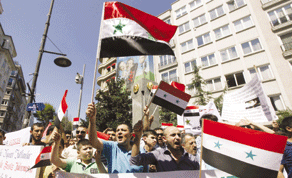
Syrian forces killed at least 23 protesters as tens of thousands swarmed the streets after Friday
 |
| Demonstrators protest against the government of Syria’s President Bashar al-Assad in front of the Syrian consulate in Istanbul yesterday |
Meanwhile, Russia and Turkey dismissed growing calls led by US President Barack Obama for Assad to quit, offering the embattled Syrian leader rare support despite a damning UN report on his “apparent shoot to kill” policy.
On the political front, a group of “revolutionary blocs” formed a coalition vowing to bring down the regime and paid tribute to more than 2,000 civilians killed in a crackdown on protesters since mid-March.
Activists said 22 protesters were killed and many others wounded in demonstrations after Friday prayers.
The Syrian Observatory for Human Rights said 15 people were killed, including an 11-year-old and a 72-year-old, in the southern province of Daraa, epicentre of the anti-regime protests that erupted on March 15.
Six were killed in the central city of Homs, one in the Harasta suburb of Damascus and another in the capital’s suburb of Douma.
The Observatory said yesterday security forces opened fire on protesters, also wounding 25 people, in the Ghabagheb, Inkhil, Al-Herak and Nawa neighbourhoods in Daraa, but the official Sana news agency blamed the shooting on “armed men.”
The agency said a policeman and a civilian were killed in Ghabagheb and six security forces wounded.
Tens of thousands of people flooded streets in major towns yesterday as they emerged from the weekly prayers, with the largest anti-regime demonstration reported in Homs.
Around 20,000 were on the streets of Al Khalidiyeh demanding the ouster of Assad, said the Observatory, which also reported rallies in the eastern oil hub of Deir Al Zor, and in the northern cities of Latakia and Banias.
Some 10,000 people marched in the Kurdish-populated cities of Qamishli and Amuda, according to an activist at the scene, while other protests took place in and around Damascus and in Hama in central Syria.
The Observatory said troops and security forces deployed in several areas to prevent protests from taking place, including in Latakia where pro-regime “shabiha’ militias pounced on worshippers as they emerged from a mosque.
Security forces opened fire and conducted arrests to prevent protests from spilling into streets in Damascus neighbourhoods.
Yesterday’s rallies put to the test a commitment given by Assad to UN chief Ban Ki-moon the previous day that his security forces have ended operations against civilians.
The Syrian Revolution 2011 Facebook group, one of the drivers of the protests, had called for the demonstrations under the slogan, “Friday of the beginnings of victory.”
The civilian death toll from the security force crackdown on the protests has now passed 2,000, UN undersecretary general B Lynn Pascoe told the UN Security Council on Thursday.
And UN High Commissioner for Human Rights Navi Pillay told the Council there was “reliable corroborative evidence” that Syrian forces are deliberately shooting anti-regime demonstrators.
Frustrated that international calls for a halt to the bloodletting were being snubbed by Damascus, US President Barack Obama on Thursday called for Assad to quit for the first time since the protests broke out.
“We have consistently said that President Assad must lead a democratic transition or get out of the way. He has not led. For the sake of the Syrian people, the time has come for President Assad to step aside,” Obama said.
His call was quickly echoed by the leaders of Britain, France and Germany while Spain followed suit yesterday.
But Russia and Turkey disagreed.
“We do not share the US and the European Union’s point of view regarding President al-Assad and will continue to pursue our consistent and principled stance on Syria,” the foreign ministry said in Moscow.
A government official in Ankara agreed and said a call for Assad’s ouster must come from the Syrian people themselves.
“First and foremost the people of Syria must tell Assad to go. This has not been heard in the streets of Syria,” the official said. “The Syrian opposition is not united and we haven’t seen yet a collective call from Syrians to tell Assad to go, like in Egypt and Libya.”
The opposition, admitting the lack of unity, announced yesterday the creation of the so-called Syrian Revolution General Commission comprising 44 “revolution blocs” due to “the dire need to unite the field, media and political efforts” of the pro-democracy movement.
Meanwhile, the UN said a much-delayed humanitarian mission would go to Syria this weekend after the claims of a shoot-to-kill policy against protesters, stadium executions and children feared killed in government custody.
And Chris Gunness, the spokesman for the UN Relief and Works Agency (Unrwa), said yesterday refugees who fled the crackdown in protest cities “are too frightened to return to their homes.”