AFP/Tripoli
Libya’s rebels pushed to strangle two supply lines to Tripoli yesterday, hoping to ratchet up pressure on the regime as their leaders prepared for the transition to democracy.

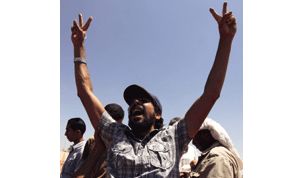
A man shouts slogans during the funeral of rebel fighters, killed in action by forces loyal to Libyan leader Muammar Gaddafi in Brega, in Benghazi yesterday
Rebels fought to sever Tripoli’s supply lines from Tunisia to the west and to Muammar Gaddafi’s hometown of Sirte in the east, as they continued efforts to translate military victories into political pressure.
Fighting continued to the west of Tripoli at Zawiyah, with rebel officials claiming they were in control of “most” of the strategically vital oil port.
The town, which contains an oil refinery, “is being heavily shelled by Gaddafi forces from the east, but the population is not scared and will not leave,” said Colonel Ahmed Omar Bani, a military spokesman.
Bani added that the rebels were now pushing west toward the Tunisian border, an apparent bid to further strangle what limited supply lines remain.
“Zabrata and Sorman are now entirely under our control,” he said referring to two towns to the west of Zawiyah, adding there was now fierce fighting on an inland road parallel to the main coastal route around the town of Ajaylat.
It was the latest in a series of operations to cut off the capital, which the rebels hope will force defections from the regime and spark a Tripoli uprising against the nearly 42-year-old regime.
East of Tripoli rebels moved toward a town that links the capital and Sirte—Gaddafi’s hometown and a stronghold for his military.
“The scouting teams of the revolutionaries reached the outskirts of Al Heisha after expelling Gaddafi forces,” the rebel military command said early yesterday.
Al Heisha lies roughly 70km south of Misrata and 250km from Tripoli, near two key crossroads that link loyalist-held territory in the west with that in the oil-rich Sirte basin.
But with rebels spread thinly across a fragmented front around Tripoli, their assault represented a slight tightening of the noose rather than the chair being kicked from under Gaddafi’s feet.
Still, anticipating victory, Libya’s rebel leaders set out a fresh plan to transform the country from autocracy to a full-blown democracy, in a road map that could help define the country for decades to come.
The draft 14-page “constitutional declaration,” obtained by AFP yesterday, plots a path - via the first elections seen in Libya since 1964 - to a new constitution and a multiparty democracy inspired by Islamic law.
“Libya is a democratic and independent state,” the document states, “the people are the source of authority, Tripoli is the capital, Islam is the religion and Islamic Shariah is the principal source of legislation.”
In 37 articles the text, drafted by the rebels’ de-facto government - the National Transitional Council (NTC) - sets out key milestones along a roughly two-year path to democracy including an assembly election, a constitutional referendum and a general election.
According to Richard Dalton, a former British ambassador to Tripoli and Tehran, the document is an admirable start.
“It is important, not only to anchor different groups within the NTC to something, but also to convince the international community about the NTC, which has been questioned after the (Abdel) Fattah Younes murder.”
Rebel military chief General Younes, a former interior minister and Gaddafi regime lynchpin, was assassinated July 28 after being recalled from the frontline in Brega for questioning. His death remains shrouded in mystery.
“It is also important to put across to the people in Tripoli that they are not just a bunch of cowboys from the east,” Dalton added.
In a possible sign that Tripoli is starting to feel the pinch, power cuts have become more frequent and mobile telephone networks are suffering increased disruptions, while calls to Tunisia have been cut for two days, an AFP correspondent in the capital said.
NTC member Wahid Bourchan, meanwhile, said yesterday that “discussions” and not negotiations did take place this week between some embattled regime members and its rebel challengers in Tunisia.
“Technocrats from the Gaddafi regime had contact with the insurgents. They asked for advice on places to go outside of the country,” said Bourchan.
“Many of the officials want to ask for political asylum in Europe and especially in France,” said Bourchan, who also heads a Libyan association based in Tunisia.
Bourchan insisted that the talks did not constitute negotiations.
“They were just individual demands,” he said.
There were reports over the past days about talks between Libyan rebels and regime representatives at the Tunisian town of Djerba, but rebel leaders denied any negotiations had taken place.