Agencies/Dubai
A prominent opposition leader is the main suspect in the attempt to assassinate Yemeni President Ali Abdullah Saleh, a member of the ruling party said in comments published yesterday.

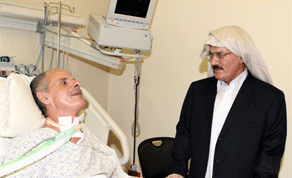
A handout picture released by the Yemeni Presidency Office yesterday shows President Ali Abdullah Saleh visiting wounded military commander Salem al-Whaishi at a hospital in Riyadh on Sunday
Saleh is clinging to power despite months of protests against his 33-year rule that have evolved in some regions into serious armed conflict, increasing fears of anarchy that could be exploited by Al Qaeda militants entrenched in Yemen.
A bomb blast in Saleh’s palace mosque in June forced him to seek medical treatment in neighbouring Saudi Arabia, where he is still convalescing from extensive burn wounds while impoverished Yemen churns in the throes of a political crisis.
“There is no longer room for doubt that Hamid al-Ahmar is the prime suspect in the sinful assassination attempt to which the president of the republic and a number of officials were subjected,” Sultan al-Barakani told the Saudi-owned pan-Arab daily Asharq Al Awsat yesterday.
“The results of the investigation indicate that the SIM cards used in the operation all belonged to the company Sabafon which is owned by Hamid al-Ahmar,” added Barakani, head of the General People’s Congress parliamentary bloc.
Sabafon is Yemen’s leading mobile network operator.
Hamid al-Ahmar is a leading figure in the powerful Ahmar tribe and a wealthy businessman with a senior position in the Islamist opposition party Islah. He is the brother of Sadeq al-Ahmar whose forces engaged in heavy fighting with Saleh loyalists in the weeks before he was injured on June 3.
Ahmar on Sunday denied responsibility for the attack that also injured the prime minister, two deputy prime ministers and the speakers of both parliamentary chambers. In an interview with Asharq Al Awsat he said Saleh’s sons and guards were behind it, in a bid to consolidate their inheritance of power.
US diplomatic cables released by WikiLeaks say that Ahmar told the then US ambassador that he wanted to draw up a plan in 2009 to force Saleh out of power involving mass protests around the impoverished country.
The cable highlights Saudi and US scepticism about whether this would be possible.
Ahmar told the ambassador Saleh needed to guarantee the fairness of parliamentary elections that were scheduled for this year and to remove his sons, whom he called “clowns”, from positions of power.
Saleh’s son Ahmed is head of the presidential guard.
The US and Saudi Arabia want to ensure a smooth transition of power in Yemen to avert instability that would give Al Qaeda militants more opportunity to solidify their position and use Yemen as a springboard for foreign attacks.
l An explosion near a government administration complex held by Zaidi Shia rebels in northern Yemen has killed two people, the rebels said yesterday.
“A bomb-laden car exploded” near a medical centre in the city of Al Matamma in Al Jawf province, northeast of Sanaa, killing two and wounding another, the rebels said in a statement of the late Sunday attack.
The rebels accused US intelligence agents of planning the “criminal attack aimed against the Yemeni revolt”, adding the blast intended to “provoke sectarian divisions between Yemenis.”
They said the attack was aimed to “help maintain the unjust regime” of Saleh.
“This is clearly a US intelligence-style criminal act” the rebels said.
The blast occurred when leaders of the Shia rebellion were meeting in the government administration complex located near the medical centre at Al Matamma, witnesses said.
The complex erupted in flames and the explosion was heard in several neighbouring villages, witnesses and tribal sources added.
The blast came two days after the signing of a truce by the Shia rebels and the Islamist Al Islah party, in a bid to stop the fighting which since March has flared intermittently in the area near the border with Saudi Arabia.
Yemen’s mountainous northern region is a stronghold of the Zaidis, also known as Houthis, who from 2004 fought six wars with central government forces before signing a truce in February 2010. The rebellion has claimed thousands of lives.