


AFP/Ramallah
The Palestinians are to present their bid for UN membership on September 20, Palestinian Foreign Minister Riyad al-Malki told AFP yesterday.

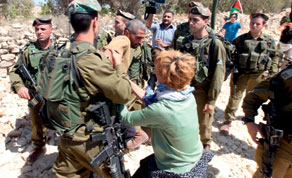
Israeli soldiers detain a protester during a demonstration against Israel’s controversial separation barrier by Palestinian and foreign peace activists in the West Bank village of Beit Omar, near Hebron, yesterday
“Palestinian President Mahmoud Abbas will personally present the request to UN Secretary General Ban Ki-moon... at the opening of the 66th session,” on September 20, Malki said.
Abbas will “insist on this historic initiative and Ban Ki-moon will present the request to the Security Council,” he said.
A senior Israeli official who requested anonymity criticised the Palestinian decision.
“Apparently Mahmoud Abbas has decided to refrain from conducting direct negotiations; this was expected and it’s a shame,” he said.
“Prime Minister Benjamin Netanyahu continues to believe that the peace process can only progress through direct and real negotiations,” he added.
Malki added that the Palestinian Authority chose September because Lebanon, holding the rotating presidency of the Security Council, would be in a strong position to push the bid forward.
“Lebanon will hold the presidency of the Security Council in September and this will help us because the president of the council has special prerogatives, which is crucial,” he said.
Following the collapse of direct peace talks with Israel in September last year, the Palestinians have adopted a diplomatic strategy of looking to secure UN recognition for a state along the frontiers which existed before the 1967 Six-Day War.
The Palestinians had already expressed their intention to ask the Security Council for UN membership in September, in the absence of negotiations with Israel before the annual UN General Assembly.
But they face opposition from the US, which threatens to derail the Palestinian bid through its Security Council veto. An application for UN membership must be approved by the council.
To circumvent the veto, the Palestinians could turn to the General Assembly, asking it to “raise (their) status to a UN observer and non-member state.”
That formula would allow them to become a full member of all UN agencies, such as WHO, Unesco and Unicef, where the Palestinians presently have no presence.
Malki said he expected that “more than 130 countries would recognise the state of Palestine” along 1967 borders.
The Palestinians are determined to go to the UN, in the absence of a realistic prospect of resuming peace talks, which have been stalled for nearly a year.
To resume talks, Palestinian officials insist on a moratorium on new Jewish settlements, including in annexed East Jerusalem, which Israel has refused despite intense international pressure.
The Israeli government, which is opposed to a unilateral approach by the Palestinians, this week announced its intention to continue building settlements in East Jerusalem neighbourhoods.
l Abbas revealed he held four secret meetings with Israeli President Shimon Peres in a bid to revive stalled peace talks, a Palestinian official said yesterday.
He quoted Abbas as saying at a meeting of his Fatah party on Friday that: “I met Shimon Peres four times in Amman and London in an attempt to restart negotiations and the peace process on a correct foundation.”
The official, speaking on condition of anonymity, added that Netanyahu had thwarted those efforts.
“Shimon Peres assured me that the negotiations between us could lead to results that could be adopted by the Netanyahu government,” the official quoted Abbas as saying.
“After the first four meetings, a fifth was scheduled in Amman, but Shimon Peres apologised and said, ‘I’m sorry but the government does not accept that we negotiate and I cannot do anything,’” Abbas said at the Friday gathering, according to the official.
Israeli media reported in early August the cancellation of a planned secret meeting in Amman between Abbas and Peres after Netanyahu’s refusal to give the president a clear mandate for negotiations.
A spokesman for the Israeli president, whose post is largely symbolic and ceremonial, declined comment.