Reuters/Cairo
Lawyers called on Egypt’s government yesterday to hand over documents that may reveal who ordered police to fire on protesters during the uprising that unseated president Hosni Mubarak, leaving more than 850 people dead.

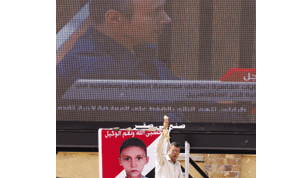
A man holds a noose as the trial of former interior minister Habib al-Adly is transmitted from Egyptian TV on a giant screen outside the police academy in Cairo yesterday
The demand came during the trials of Egypt’s reviled former interior minister Habib al-Adly and Mubarak over the killings, which have captivated Egyptians with real-life drama to trump the most popular Ramadan-season TV soap operas.
Adly was in charge of a massive security apparatus blamed for systematic rights abuses and the smothering of all opposition to Mubarak’s 29-year rule.
The ex-minister and six of his lieutenants, who are charged with the killings and corruption, watched from the court’s steel cage yesterday as dozens of lawyers for the plaintiffs jostled towards the judge’s bench to list their demands.
All seven defendants face the death penalty if convicted over the killings.
Tension pervaded the busy courtroom.
Security men struggled to keep order as the family of a dead protester scuffled with relatives of a dead police officer whose photo was held up to commemorate his death.
The protester’s family demanded that the photo be removed, saying the officer was a killer not a victim.
“The judge abruptly ended the session which got out of hand because of over-enthusiasm and rising emotions,” Gameel Saeed, representing one top officer accused with Adly, said.
Judge Ahmed Refaat set the next hearing for September 5.
Mubarak’s trial resumes today.
The trials of Adly and Mubarak, who appeared in court on August 3 and denied any role in the killings, have gripped audiences across the region.
Police fired live ammunition, rubber bullets and teargas as the protests spread inexorably across the country of 80mn. On February 2, Mubarak loyalists mounted on camels and horses charged into protesters in Cairo’s Tahrir Square.
Amir Hamdy Salem, a lawyer for some of the plaintiffs, demanded to see all communication between Mubarak and Adly stored in the presidential palace and Mubarak’s residence.
He demanded written correspondence and records of calls between Mubarak and his ex-intelligence chief Omar Suleiman kept in Egyptian intelligence headquarters.
He also requested logbooks showing orders given by Adly and Hasan Abdel Rahman, the head of state security, to officers trained as snipers as well as logs of the ammunition used.
“Regarding the request to continue to view evidence, the court will consider it,” said judge Refaat.
Lawyers for the plaintiffs also requested testimony from the chief executives of mobile phone firms Mobinil, Etisalat and Vodafone Egypt.
The government shut down telecom services during the uprising as activists sought to build critical mass for the demonstrations using text messaging, Facebook and Twitter.
“What is already available in existing files does not fully make clear who gave the order to cut communication,” Salem said.
Tarek El Awady, director of the Egyptian Museum by Tahrir Square, said taped security camera footage that captured the camel attack was sent to the military council and investigative bodies, the state news agency Mena reported on Saturday.
As security chief, Adly was the target of animosity from much of the population. But many Egyptians were unsure whether the ruling military council would subject former army officer Mubarak to the humiliation of a public trial.