


Reuters/Amman/Hama, Syria
 |
|
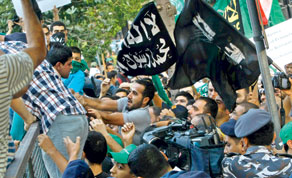
Supporters of an Islamist movement (R), who were demonstrating against the Syrian regime, clash with supporters of Syrian President Bashar al-Assad during their respective protests outside the Syrian embassy in Beirut yesterday |
They said the killings occurred when troops backed by tanks swept into Qusair, near the Lebanon border, after overnight protests calling for Assad’s removal. One person was also killed in the coastal city of Latakia.
Around 14 tanks and armoured vehicles also swept into Saraqeb, a town on Syria’s main north-south highway that has seen daily demonstrations, and 100 people were arrested by the security forces, residents said by telephone.
Syria’s northern towns have been a particular target in recent days of the crackdown on demonstrations calling for Assad’s overthrow, inspired by popular revolts against rulers elsewhere in the Arab world.
Officials escorted a group of Turkish reporters around the city of Hama yesterday after a week-long crackdown. However, Syria has barred most independent journalists since the uprising against 41 years of Assad family rule flared five months ago, making it difficult to verify accounts from both sides of events on the ground.
At least 1,700 civilians have been killed in the unrest, rights groups say, and a series of military assaults on cities and towns since the start of the Muslim holy month of Ramadan 10 days ago has sharpened international condemnation.
The US ambassador to Damascus warned Syria yesterday of more US sanctions if violence does not stop, a day after Washington imposed sanctions on a Syrian state bank and on Syria’s biggest mobile telephone company.
Regional powers Turkey, Saudi Arabia and Egypt have all added pressure on Assad to stop the violence, although no country has proposed the kind of military intervention being carried out by Nato forces against Libyan leader Muammar Gaddafi.
Syria says 500 soldiers and police have died in the bloodshed, which it blames on armed gangs and terrorists.
In Hama, main streets were empty yesterday, windows shuttered and most shops closed after the week-long military assault to crush protests in the city which became a symbol of defiance against Assad.
A day after authorities announced the army had pulled out, following the crackdown in which activists said scores of people were killed, the government appeared in full control.
No tanks could be seen but armed, uniformed men stood on rooftops, soldiers manned a series of checkpoints into the city, and the governor’s building in the central square was flanked by two military vehicles topped by machine guns.
Several residents, their comments translated to the visiting Turkish journalists by Syrian officials, said the army moved in after the city was taken over by groups who had blocked roads and burnt state buildings.
But one youth, his face masked and only his eyes visible, had a different message. “You see us, we have no weapons, but they are attacking us with tanks and planes,” he said. “And I tell President Assad that, even though it will be difficult, we will get you out of power.”
Syrian human rights group Sawasiah said at least 30 people were arrested in dawn raids in the northern countryside near Aleppo, while similar arrest took place in the northern Idlib province, Damascus suburbs and the southern Hauran Plain.
Another activist group, the Local Coordinating Committees, said nine detainees had died from torture in detention over the last 10 days in Damascus, Homs, Deraa and Damascus suburbs.
European members of the UN Security Council on Wednesday warned Syria that it could face tougher UN action if Assad continued the onslaught against protesters, while Russia urged Damascus to implement promised reforms as soon as possible.
But Russia and China, both with veto powers in the Council and backed by India, South Africa and Brazil, have vehemently opposed the idea of slapping UN sanctions on Damascus, which Western diplomats say would be the logical next step.
Envoys of Britain, France, Germany and Portugal spoke to reporters after a closed-door session of the 15-nation council convened to assess Syria’s compliance with last week’s call by the world body for “an immediate end to all violence”.
They said the Syrian leadership has ignored that demand.
Despite the worsening bloodshed, there appears little prospect that Western states will put teeth on the sanctions on Assad by targeting Syria’s vital oil industry because of vested commercial interests abroad against doing so.