Reuters/Jerusalem
Israel must change to ease the pain of high living costs, a committee said yesterday after being tasked by the government to address the demands of thousands of protesters who have rocked the political establishment with mass demonstrations.

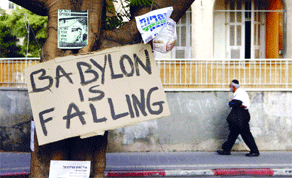
A sign hangs on a tree on Rothschild Boulevard in Tel Aviv yesterday as part of a protest against high costs of living
“There is a real desire in this wave of protests for something of substance, called social justice,” economist Manuel Trajtenberg, chairman of the 14-member panel of experts, said in a statement issued at its inaugural session.
“I am excited by the rare opportunity to effect a change for the good in our beloved country, and we have no other option but to succeed in our mission.”
A quarter of a million people took to the streets of Tel Aviv, Israel’s commercial capital, on Saturday to push an array of demands, including a call for cheaper housing and a cut in sales taxes.
It was the biggest socio-economic demonstration in Israel’s history and more protests are planned, in smaller cities, this weekend.
While Prime Minister Benjamin Netanyahu’s governing coalition faces no immediate threat, protests that began last month have underscored the potential electoral impact of a burdened middle class rallying under a banner of “social justice” and rewriting a political agenda long dominated by security issues.
A day after Saturday’s rally, Netanyahu—a champion of free market reform—appointed the committee, which plans to meet protest leaders and submit reform proposals to the government within a month.
Protesters’ demands, which have focused on economic reform rather than political change, have included an overhaul of the tax system, more funds for housing projects for the needy and expanding free education to include nurseries.
Netanyahu has cautioned publicly that he would not be able to satisfy all of the demands. But he also said that he recognised that many Israelis were suffering real hardship.
In under a month, the protest movement has swollen from a cluster of student tent-squatters into a diffuse, countrywide mobilisation of Israel’s middle class.
Israel projects growth of 4.8% this year at a time of economic stagnation in many Western countries, and has relatively low unemployment at 5.7%.
But business cartels and widening wage gaps have kept many citizens from feeling the benefit of the strong economy.
The conservative coalition government has vowed to free up more state-owned land for development, build more low-cost housing and improve public transport. It also wants to lower dairy prices with more imports and boost medical staff numbers to address demands by striking doctors.
Reaction among protest leaders to the committee’s appointment has been mixed, with some welcoming a dialogue with the panel and others voicing doubts it could persuade the government to accept any far-reaching proposals.
The demonstrations have upstaged Netanyahu’s standoff with the Palestinians before their bid to lobby for UN recognition of statehood next month.
Protests also deflated his celebration of Israel’s stability as popular uprisings rock surrounding Arab states across the Middle East and North Africa.