


 |
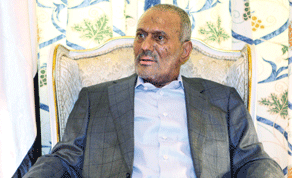
They said that message was conveyed directly to Saleh, who emerged on Sunday from the Riyadh hospital where he had been receiving treatment since a bomb attack in his palace on June 3 left him with severe burns and other wounds. The sources did not indicate whether Saleh accepted that request.
The latest development in the wrangle over Saleh’s fate came as he renewed a vow to return as soon as his health permits to Yemen, where six months of protests demanding his ouster have seen the impoverished state slide toward the brink of civil war.
Yemen’s state news agency said yesterday Saleh’s doctors would determine the length of that recovery.
The US and Saudi Arabia, both targets of foiled attacks from Al Qaeda’s Yemen-based branch and wary of chaos that could embolden the group, have tried to ease Saleh from office with a plan brokered by Yemen’s richer Gulf neighbours.
Saleh agreed to the deal but backed out of signing at the last minute on three separate occasions, the last of which kindled weeks of fighting between his forces and fighters from the al-Hashed tribal grouping, which supports calls for an end to his 33 years of autocratic rule.
Yesterday, the US ambassador to Yemen, Gerald Feierstein, urged Saleh to allow the power transfer that deal envisioned.
“We believe...dealing with the political, economic and security problems in Yemen cannot happen without a transfer of power in the country, and the arrival of new leadership in the country,” he told the US Arabic-language broadcaster Radio Sawa.
His remarks echoed those of US State Department spokesman Mark Toner on Monday. When asked about reports that Washington had asked Saleh not to return, Toner urged an immediate transfer of power to his deputy, the acting head of state.
“We’ve also said that this is something that cannot wait until a decision is made regarding President Saleh’s future, that we’ve got an acting president, and ... they need to move towards this transition immediately.”
The transition plan, brokered by the six-nation Gulf Co-operation Council, has been moribund since Saleh last avoided signing it in May, triggering fighting between his forces and those of the al-Ahmar family, a leading part of the Hashed group.
A further centre of power is represented by General Ali Mohsen, a top general who turned on Saleh and sided with the protesters, against whom forces loyal to Saleh turned their weapons as calls for his removal intensified.
Analyst Ali Seif Hassan said the deadlock between forces commanded by Saleh’s son and nephews, those of tribal chief Sadeq al-Ahmar, and Mohsen may only be resolved by a far more complicated bargain that changes the balance on the ground.
“The only way he will agree not to return is if Ali Mohsen also consents to leave. They were in power together, committed crimes together, and his (Saleh’s) group will not consent to Mohsen remaining while the president accepts being gone.”
Relative calm has mostly held in the capital since Saleh’s departure, even as long-standing conflicts in Yemen’s south have reignited, including a fight with Islamists that has led to a mass exodus of the population of one southern province.
The collection of leftist, Islamist, socialist and other political parties which inked the deal that Saleh rejected have been shunned by the street protesters, whose leaders disdain them as long-time collaborators of Saleh.
The opposition said yesterday it will elect an umbrella “national council” aiming to take over power.
The parliamentary Common Forum opposition set August 17 for a meeting “to establish the (proposed) national assembly, which will form an umbrella for the revolution and choose members of a national council,” it said.
The council aims to “lead the revolution forces to move ahead with change that will fulfil the aspirations of the Yemeni people,” it added.
The opposition has been discussing the proposed council for months. It hopes to unite the parties of the Common forum, which include the influential Islamist Al Islah (reform) party, along with the anti-regime protesters.
It will also include representatives of civil society, members of the secessionist Southern Movement and the northern Shia Houthi rebels, in addition to independent activists.
The council aims to support the protesters, co-ordinate between them and the parliamentary opposition, and to create a plan for overthrowing the regime, according to the opposition.
Members of the council will be chosen from more than 700 activists representing all pro-revolution political forces in Yemen, Common Forum alliance spokesman Mohamed Sabri said.
UN voices concern
The UN Security Council yesterday expressed “grave concern” at the worsening economic and humanitarian situation in Yemen following months of a popular uprising. India’s UN ambassador Hardeep Singh Puri, who is serving as the council president in August, read an official statement to reporters cautioning also about the worsening security situation resulting from “the threat of Al Qaeda in the Arabian Peninsula.” “The members of the Security Council urged parties to ensure access for the provision of humanitarian assistance, expressed their concern about the interruption of basic supplies, and urged all parties not to target vital infrastructure,” Puri said. The council called for all Yemeni parties to move forward urgently to an “inclusive, orderly and Yemeni-led process of political transition.”