


 |
| We hope that Sudan and South Sudan will have good neighbourly relations based on the exchange of benefits, which will enhance stability |
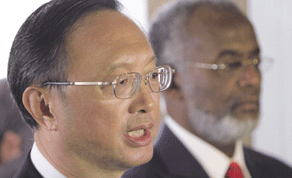
“Whatever happens in the region and elsewhere in the world, we will continue our efforts to develop friendly and co-operative relations with Sudan,” Yang told a news conference after meeting his Sudanese counterpart Ali Karti.
Yang, who is on a two-day visit to Khartoum, said his country would assist Sudan in building up its key economic sectors.
“China is ready to help Sudan in developing its existing oil fields and production. At the same time, we are willing to develop our co-operation in agriculture and other sectors, such as mining, bridge and road building, and communications,” he said.
A key ally of Sudan, which has suffered from US economic sanction since 1997, the rising world power is also a major military supplier to the regime in Khartoum, as well as one of the largest foreign investors and the biggest buyers of Sudanese oil.
Yang offered Sudan a 100mn yuan ($15.5mn) interest-free loan during his visit, according to Karti. He was due to meet President Omar al-Bashir later yesterday.
Bashir, who is wanted by the International Criminal Court for war crimes in the Darfur region of west Sudan, travelled to Beijing shortly before last month’s secession of the south, where most of Sudan’s oil lies, to boost bilateral ties.
Analysts say one of the main reasons for Bashir’s visit was to strengthen his position in the face of pressures exerted by China’s partners in the UN Security Council.
Karti yesterday thanked China for its support in the Security Council and the UN Human Rights Council, telling reporters that that because of this, “many negative parts” of the resolution extending the mandate of the UN peacekeeping force in Darfur had been successfully removed.
He said the Chinese had vowed to push CNPC, their state-owned oil giant, for more investment in Sudan.
CNPC dominates the Sudanese oil sector, and many of the fields it operates are located in the volatile border states of Unity and South Kordofan.
During his visit, China’s top diplomat urged north and south to find “urgent solutions” to their outstanding differences for the sake of stability, just days after a dispute over duty payments caused the authorities in Port Sudan to block a 600,000 barrel shipment of southern oil.
“We hope that Sudan and South Sudan will have good neighbourly relations based on the exchange of benefits, which will enhance stability,” Yang said.
Agreement on oil transit fees, the demarcation of their shared borders, and how to divide Sudan’s crippling debt are some of the key issues that north and south have yet to resolve.
Yang is due to travel to Juba, capital of newly-independent South Sudan, today.
Yang said China will continue its efforts with the international community to find a final solution for the issue of the disputed area of Abyei.
North Sudan and South Sudan both hope to include Abyei in their territory, but Khartoum and Juba have yet to agree on who will control Abyei, stirring fears a long-running quarrel over the region could sour the secession and spark a broader conflict.
Yang said China is paying attention to the ongoing violence in South Kordofan.
“China is following the recent development of the situation in South Kordofan State and it has exerted efforts with the concerned parties to calm the situation there,” he said, adding that China supports the mediation efforts led by the African Union.