AFP/Damascus
Syrian security forces killed more than 50 people yesterday, activists said, as the president defended the crackdown on “outlaws” and the Pope and Arab League added their voices to condemnation of the violence.

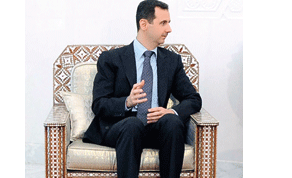
A handout picture released by Syrian news agency Sana shows President Bashar al-Assad during a meeting with Lebanese Foreign Minister Adnan Mansour (not pictured) in Damascus yesterday
The US envoy to Damascus, Robert Ford, who returned to Syria on Thursday, also said in a US television interview broadcast yesterday that Washington will “try to ratchet up the pressure” on President Bashar al-Assad’s regime.
The latest bloodshed came as Pope Benedict XVI said he was “following with deep concern the dramatic and increasing episodes of violence in Syria that have led to numerous victims and grave suffering.”
Ford, who infuriated the Syrian authorities with a visit to the flashpoint protest city of Hama last month, also told ABC news that the violence against protesters was “grotesque” and “abhorrent.”
Activists said security forces backed by tanks killed 42 civilians in the eastern city of Deir Al Zor and at least 10 more in the central town of Hula yesterday.
“Forty-two civilians have been killed and more than 100 wounded in Deir Al Zor by gunfire from the armed forces and security agents,” Syrian League for the Defence of Human Rights head Abdel Karim Rihawi said.
Rihawi said that 28 people were killed in Deir Al Zor’s Al Jura neighbourhood and 14 died in Huweika district, adding that “thousands of people have fled the city heading further north.”
In Hula in Homs district, at least 10 people were killed in a military assault, Rihawi said.
“About 25 tanks and troop carriers entered Hula and carried out military operations,” another activist, Rami Abdel Rahman of the Britain-based Syrian Observatory for Human Rights, said earlier.
The Local Co-ordination Committees which organised the protests said on Facebook that snipers were on rooftops in Deir Al Zor “are firing on anything that moves,” and also gave a toll of 42 dead.
But Assad roundly defended his security forces.
“To deal with outlaws who cut off roads, seal towns and terrorise residents is a duty of the state which must defend security and protect the lives of civilians,” state news agency Sana quoted him as saying.
In contrast to Assad’s reference to “outlaws,” the Pope called yesterday for an adequate response to the “legitimate aspirations” of the Syrian people.
Ford told ABC he would continue travelling across Syria to observe the crackdown first-hand.
“I don’t particularly care (about angering Damascus), because we have to show our solidarity with peaceful protesters,” said Ford.
“I’d do it again tomorrow if I have to. I’m going to keep moving around the country. I can’t stop.”
“We are going to try to ratchet up the pressure,” Ford said.
The Arab League also made its first official statement on the unrest, calling on Damascus to “immediately” stop the violence that has rocked the country since mid-March.
Secretary General Nabil al-Arabi also urged an “impartial probe” into the bloodshed, warning against “chaos” and “religious strife” in Syria, it said.
Arabi expressed his “increasing concern” because of “the deterioration of the security situation in Syria following the rise in violence and military operations in Hama, Deir Al Zor and several regions.”
On Saturday UN chief Ban Ki-moon phoned Assad to express similar concerns, UN spokesman Martin Nesirky said.
Ban “reflected to the Syrian president the clear message sent by the (UN) Security Council and urged the president to stop the use of military force against civilians immediately.”
US and European leaders have pledged to consider new steps to punish Syria after security forces killed more than 30 people on the first Friday of Ramadan.
Syria’s government has sought to crush the democracy movement with force, leaving at least 2,059 people dead, including 391 members of the security forces, according to the Syrian Observatory.
The Assad regime has pledged reform and accused “armed terrorist gangs” of fomenting the unrest.
On Saturday Foreign Minister Walid Muallem said “free and transparent” elections to a new parliament would be held by the end of 2011 and that the regime was committed to reform announced by Assad.