


AFP/Damascus
Syria vowed yesterday to hold “free and transparent” elections by the end of 2011 as Arab states in the Gulf joined a chorus of Western pressure over its deadly suppression of anti-regime protests.

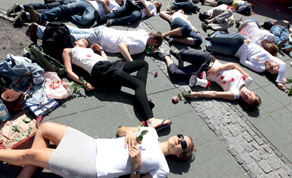
People take part in an Amnesty International demonstration in Berlin yesterday in solidarity with Syria’s anti-government protesters
An activist, meanwhile, said hundreds of tanks and armoured cars had been deployed in the northeastern city of Deir Al Zor and around Homs in central Syria.
“Syria will hold free and transparent elections that will give birth to a parliament representing the aspirations of the Syrian people,” Foreign Minister Walid Muallem said in a meeting with ambassadors posted to Damascus.
“The general elections will be held before the end of the year,” Muallem said, quoted by the official Sana news agency.
The foreign minister stressed “the commitment of the Syrian leadership to the continued reform process and implementation of measures announced by President (Bashar al-) Assad.”
The embattled president issued a decree on Thursday allowing opposition political parties, but the move was largely dismissed by the opposition as a ploy to appease protesters.
Gulf Arab states yesterday turned up the heat on Damascus, with the six-nation Gulf Co-operation Council calling in a statement for an “immediate end to violence... and bloodshed.”
They urged a “resort to wisdom and introducing serious and necessary reforms.”
Their call followed a pledge by the US, French and German leaders to consider new steps to punish Syria after a deadly crackdown on the first Friday of Ramadan.
President Barack Obama spoke separately to France’s Nicolas Sarkozy and German Chancellor Angela Merkel as Western nations cranked up pressure on Assad.
They “condemned the Assad regime’s continued use of indiscriminate violence,” the White House said. They “also agreed to consider additional steps to pressure the Assad regime and support the Syrian people.”
German Foreign Minister Guido Westerwelle, in an interview to be published today, said Assad no longer has a future in Syrian politics.
“I don’t believe that Assad has a political future ahead of him which is supported by the Syrian people,” Westerwelle told the newspaper Allgemeine Sonntagszeitung.
The Syrian government has sought to crush the democracy movement with brutal force, killing around 1,650 civilians and arresting thousands of dissenters, according to the Syrian Observatory for Human Rights.
Rami Abdel Rahman, head of the Britain-based Syrian Observatory, said by telephone that around 250 tanks and armoured cars were deployed in four districts of Deir Al Zor yesterday.
The tanks were also posted around the airport in Deir Al Zor, many of whose residents started to flee the city from Wednesday, fearing imminent military action.
In Homs, “many armoured cars and other army vehicles have been posted in the Bab Al Sibaa district,” Abdel Rahman said, adding that activists in the city reported gunfire from early morning.
In the latest bloodshed, Abdel Karim Rihawi, who heads the Syrian League for the Defence of Human Rights, said 22 people were killed on Friday, including seven after the special evening prayers for Ramadan.
Seven of the fatalities were in Irbin, three in Damir and one in Maadamiya, all near Damascus, he said by telephone. Three others were killed in Homs and one in Nawa, southern Syria.
Sana, meanwhile, said two members of the security forces were killed and eight wounded on Friday in an ambush on a road in the northwestern Idlib region, near the Turkish border.
On Friday, communications were completely cut off as the army stepped up an operation to crush dissent in Hama, the central city where security forces killed at least 30 civilians and wounded dozens more earlier in the week.
More than 1,000 families have fled the city, according to Abdel Rahman.
“Thousands of demonstrators marched in Deir Al Zor, Daraa and Qamishli in support of the city of Hama despite the extreme heat” on Friday, said Rihawi, adding they numbered 30,000 in Deir Al Zor alone.
Prominent opposition figure held: activist
Security forces yesterday arrested prominent opposition figure and former political prisoner Walid al-Bunni and his two sons, Syrian Observatory for Human Rights chief Rami Abdel Rahman said. “The Syrian security services on Saturday evening arrested opposition figure and ex-political prisoner Walid al-Bunni” and his sons Moayed and Ayad, the Britain-based Abdel Rahman told AFP in Cyprus by telephone. A doctor by training, the 47-year-old is one of the most high-profile members of the opposition in Damascus. In 2000, Bunni was one of the prime movers of the short-lived “Damascus Spring” amid hopes for reform that followed Bashar al-Assad’s accession to the presidency. In May, Amnesty International said Bunni was one of several rights activists in Syria “forced into hiding after receiving threats from Syrian authorities.” Bunni was one of 12 signatories of the 2005 Damascus Declaration, which called for democratic change in Syria, who were sentenced to 30 months in jail in October 2008 for “damaging the state.” He was last released in June 2010.