


 |
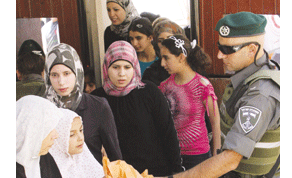
| Palestinian women pass an Israeli checkpoint on their way to the Ibrahimi Mosque in the West Bank city of Hebron yesterday |
While the ousted president appeared in court this week on a stretcher, smugglers from the Palestinian territories—under an Israeli blockade since 2006 with Egypt’s tacit co-operation—were enjoying their newfound freedoms.
“Things have changed with the situation in Egypt. It’s chaos out there,” said Mohamed, 27, who runs a tunnel where workers were hoisting bags of cement.
Trade in cement, which is on an Israeli list of banned goods on grounds it could be used for military purposes, has risen by up to five-fold since the political shift in Egypt.
“Now, 150 tonnes per day passes through, before it was 20 to 30,” said Mohamed, sporting a moustache and cropped hair, sitting on a mat sipping coffee.
The sudden influx has dramatically slashed prices.
“A bag of cement is now worth 25 shekels ($7), at 20 bags per tonne,” he said. “Before, the price had risen to 200 shekels.”
“The people of Hamas do not collect taxes for the moment,” the young entrepreneur said.
“They just check that we do not bring in illegal goods, like drugs.”
But Hamas, the Islamist movement that controls Gaza, recently set up roadblocks to filter access to the border area.
It also undertook to identify the tunnels, closing those that are unfinished or abandoned in order to apply the ban on items such as drugs or alcohol, and collect a tax on other goods.
“Hamas comes to inspect every week and takes about 20 shekels ($5.60)” per tonne of cement, said a young man at another tunnel, who also identified himself only as Mohamed.
“There have been more controls in recent weeks,” he added.
Tonnes of iron transit through another tunnel that is 25m deep and 750m long. Iron is now available on demand on the other side of the border.
“There was much more security on the Egyptian side before,” said Mohamed, who works in a 12-man team, doing a 12-hour shift for 250 shekels ($71) per day.
The permanent opening of the Rafah passenger terminal, decreed in May by the new Egyptian government, did not dampen the smuggling, because of a lack of facilities through the legal route.
Travellers at Rafah must register for permission to cross to Egypt two or three months in advance.
According to the latest weekly report of the Office for the Co-ordination of Humanitarian Affairs (OCHA), about 700 people on average leave Gaza through Rafah every day and 600 enter.