AFP/United Nations
The UN condemned yesterday the Syrian government’s deadly crackdown on protests and called for those responsible to be held “accountable,” as tanks stormed the protest hub of Hama.

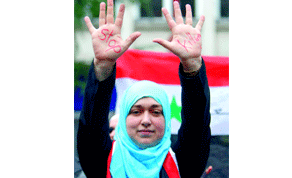
A demonstrator shows her hands during a protest against the Syrian government outside the country’s consulate in Istanbul yesterday
A Security Council statement agreed after weeks of often-acrimonious talks said the body “condemns the widespread violations of human rights and the use of force against civilians by the Syrian authorities.”
“The Security Council calls on the Syrian authorities to fully respect human rights and to comply with their obligations under applicable international law. Those responsible for the violence should be held accountable,” the text read.
The council also called on Syrian authorities to “co-operate fully” with the UN High Commissioner for Human Rights.
Lebanon disavowed the statement, saying it would “not help” end the Syrian crisis.
At the same time, the US hardened its line on Bashar al-Assad, with White House spokesman Jay Carney saying Washington had no interest in seeing the Syrian president survive just to preserve regional “stability.”
As the diplomatic wrangling drew to a conclusion, Syrian tanks had stormed the city of Hama, activists said.
“There are some 100 tanks and troop carriers on the highway leading to the central city of Hama and about 200 tanks around the eastern city of Deir Al Zor,” said Britain-based Syrian Observatory for Human Rights chief Rami Abdel Rahman.
Telephone and Internet communication were cut in Hama and nearby areas, he said.
Abdel Raman also reported that a local official in Deir Al Zor “received advice from well-informed sources that residents should flee while they still had time before the army storms the town by Friday.”
In Hama, tanks were deployed in several districts and shelling could be heard across many neighbourhoods, another activist said.
“From the sound of the shelling, it sounds like it’s open warfare.”
The Local Co-ordination Committees, which represents the protesters, said plumes of smoke could be seen over the city of 800,000 residents.
“People are deserting the city and are faced by live gunfire from security forces and army troops if they don’t respond to orders to go back inside,” a statement said.
The accounts could not be independently verified as foreign reporters are not allowed to travel in Syria to report on the unrest.
The fierce crackdown on Hama, where an estimated 20,000 people were killed in 1982 when Assad’s father Hafez crushed an Islamist uprising, has prompted solidarity protests across Syria and international condemnation.
In other developments, a mosque official said between 800 and 1,000 people demonstrated after prayers in the northwestern city of Latakia and were dispersed by police with batons. Thirty people were said to have been arrested.
The Security Council had been struggling since Monday over how to respond to the crisis, with European powers and the US seeking a tough condemnation.
Russia, China and some other nations initially blocked any action, saying it could lead to a Libya-style military intervention by the West.
But yesterday, ambassadors agreed to a text that would “condemn” Syria, diplomats said.
Following those changes, Russia lifted its objections, with UN envoy Vitaly Churkin calling the new version “balanced.”
It was the council’s first pronouncement on Syria since protests started on March 15.
The statement dropped references to a human rights inquiry that Britain, France, Germany and Portugal had called for in their earlier versions of the text.
But it said those responsible for the violence would be held “accountable.”
UN Secretary General Ban Ki-moon had joined the fray earlier this week, saying the Syrian president “lost all sense of humanity.”
At the White House, meanwhile, Carney said Washington did not view Assad as “indispensable,” saying he was completely “incapable and unwilling” to respond to the grievances of his own people.
“The US has nothing invested in Assad remaining in power. We do not want to see him to remain in Syria for stability’s sake and rather we view him as the cause for instability in Syria,” Carney said.
Some analysts have speculated that Washington was wary of directly calling for Assad to quit because of anxiety that security chaos, even civil war, and a Middle East power vacuum might follow the demise of his regime.
Global condemnation of the crackdown mounted after weekend violence in which an estimated 140 people were killed in a military assault on Hama and other protest towns.
Meanwhile funerals were held yesterday for seven members of the security services and army who were killed by “armed terrorist gangs” in a suburb of Damascus as well as in Homs, Hama and Daraa, the official news agency Sana said.
State television also aired an amateur video showing corpses being thrown from a bridge into a river, and said the bodies were of security forces killed by protesters. But activists challenged that account, saying the victims were pro-democracy protesters killed by the army.
According to the Syrian Observatory 1,629 civilians and 374 members of the security forces have been killed since pro-democracy protests erupted in Syria on March 15.
On the domestic front Sana said parliament would meet in an extraordinary session on Sunday to discuss “issues concerning the nation and its citizens.” It did not elaborate.