AFP/Damascus
Syrian tanks shelled the city of Hama yesterday after a day in which 100 people died, activists said, as President Bashar al-Assad praised his troops ahead of a UN Security Council meeting.

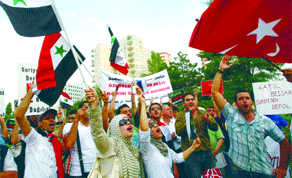
Members of a pro-Islamic human rights group demonstrate against Syrian President Bashar al-Assad’s regime outside the Syrian embassy in Ankara yesterday
The Security Council was to hold closed consultations from 2100 GMT, a spokesman said, following demands from European powers to condemn Assad’s deadly crackdown on opposition protests.
Syrian forces on Sunday killed around 140 people across the country, including more than 100 in Hama, scene of an Islamist revolt in 1982 that was crushed at the cost of an estimated 20,000 lives.
Rami Abdel Rahman, who heads the Syrian Observatory for Human Rights, called Sunday “one of the deadliest days” since the pro-democracy protests broke out in mid-March.
“Ten tanks are shelling Dawar Bilal indiscriminately,” an activist told AFP in Nicosia by phone as the booms of explosions were heard in the background. He was referring to a residential area on the outskirts of Hama.
The head of the Syrian League for the Defence of Human Rights, Abdel Karim Rihawi, said “intense shooting” was heard across Hama late yesterday, the first night of Ramadan.
The official Sana news agency said troops were locked in clashes with “saboteurs” in the city.
“The army is pursuing its mission in Hama and is removing barricades erected by groups of saboteurs at the entrances of the city,” Sana said.
Assad yesterday marked Army Day by showering his troops with praise even as international condemnation swelled ahead of the UN meeting on the crisis.
The army had “proved its loyalty to its people, country and creed,” Assad said. “Its efforts and sacrifices will be admired. These sacrifices succeeded in foiling the enemies of the country and ending sedition, preserving Syria.”
The embattled president also visited wounded soldiers in a Damascus hospital and said “all Syrians appreciate the army,” Sana reported.
At least 1,603 civilians and 369 members of the army and security forces have been killed since mid-March in Syria, according to the Observatory.
Abdel Rahman said four more civilians were killed by security forces yesterday in Hama while a boy aged 13 and another person were shot dead in the eastern town of Al Bukamal.
He also reported that tanks rumbled yesterday into Al Bukamal, on the border with Iraq, some two weeks after troops surrounded the town which official media said was used as a passage point to smuggle in weapons and money.
Reinforcements were also dispatched further north to Deir Al Zor, another rallying point of anti-regime protests where troops deployed on Saturday.
“More than 80 tanks are heading there, in what appears to be the prelude to a vast military operation,” said Abdel Rahman, quoting residents in Deir Al Zor, Syria’s oil hub.
Troops backed by tanks also stormed the town of Al Hulla, northwest of Syria’s third city Homs, where residents reported heavy gunfire and said 15 people were wounded and 18 arrested, according to the Observatory.
Tanks were also closing in Zabadani and troops erected barricades to seal off the town northwest of Damascus, according to Rihawi.
The deadly crackdown triggered a torrent of Western condemnation, with criticism coming even from traditional allies like Russia, while the European Union said it would impose fresh sanctions on Damascus.
EU foreign policy chief Catherine Ashton urged the Security Council to take a “clear stand” and confirmed that a new set of sanctions would be imposed from today on five Syrians “involved in or associated with the violence.”
British Foreign Secretary William Hague called for “stronger international pressure” on Syria, “including from Arab nations” and Turkey, but ruled out military intervention, in statements to BBC radio.
“We want to see stronger international pressure all round, and of course to be effective that can’t just be pressure from Western nations,” Hague said.
But he stressed there was no prospect of achieving a UN mandate for military intervention such as in Libya. “It’s not a remote possibility, even if we were in favour of that, which we’re not.”
Nato chief Anders Fogh Rasmussen told a French newspaper the lack of a UN mandate and regional support meant the conditions were not met for a Libya-style operation.
“In Libya, we’re carrying out an operation based on a clear UN mandate. We have the support of countries in the region. These two conditions are not met in Syria,” Rasmussen said.
A UN meeting could reopen bitter divisions within the Security Council, which has been unable to agree even on a statement on Assad’s crackdown.
“There is outrage over the new deaths, even Russia’s foreign ministry has condemned it, but I am not sure it is going to be enough to change the council dynamics,” said one diplomat, speaking on condition of anonymity.
Britain, France, Germany, Portugal and the US have pressed for weeks for condemnation of the violence but Russia and China—angered by the Nato bombing campaign in Libya—have threatened to veto any formal resolution against Assad.
However, Moscow yesterday urged Damascus to immediately stop using force and repression against civilian protesters, in its strongest criticism yet of the Syrian crackdown.
“The use of force against both peaceful civilians and representatives of state structures is unacceptable and should be stopped immediately,” Russia’s foreign ministry said.
To back up the point, Russian Deputy Foreign Minister Andrei Denisov later made clear Moscow’s anxiety in telephone talks with Syrian Foreign Minister Walid Muallem, calling for dialogue to solve the crisis.