


 |
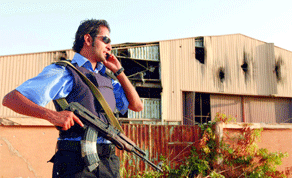
| A policeman stands guard outside a damaged warehouse in Benghazi yesterday following deadly overnight clashes between rebels and a loyalist group |
Medics and rebels said at least four rebel and 11 pro-Gaddafi fighters were killed in the fierce shootout, which erupted around dawn during a raid on the cell holed up at a roadside factory in the eastern city.
“It was a long battle and it took many hours because they were heavily armed,” rebel spokesman Mahmoud Shammam said. “In the end we arrested 31 of them. We lost four people.”
Doctor Morad Drissi at Al-Jalaa hospital said 11 of the pro-Gaddafi fighters were killed and that he treated 42 wounded rebels.
Motasem Nayed, a surgeon at Benghazi Medical Centre, said: “Four rebels remain in the intensive care unit, most of them in critical condition”.
Shammam said the group suffered “about 20 casualties” before being rounded up for its role in organising a prison break in Benghazi earlier in the week.
The rebels said they mounted the operation after the armed group refused to enter negotiations, flouting an order from the opposition’s National Transitional Council (NTC) for all brigades outside its newly formed unified command structure to disband and lay down their arms.
The pro-Gaddafi cell “had plans to plant car bombs in Benghazi,” according to Mustafa al-Sagazly, deputy chief of the rebel-backed February 17 brigade which carried out the raid.
“We found a large number of explosives typically found in car bombs.”
He added the “very same group”—the Katiba Yussef Shakir—was suspected in the assassination of General Abdel Fattah Younes, a right-hand man to Gaddafi before his defection to the rebel ranks, whose death remains cloaked in mystery.
Ismail al-Salabi who heads military operations for the February 17 brigade called the operation “100% successful.”
The factory contained TNT explosives and about seven pickup trucks armed with machine guns, a rebel said.
“There were also green flags and portraits of Gaddafi which we took and burned,” said Mohamed Duma.
In the aftermath of Younes’s assassination, the NTC has issued repeated warnings to militia groups—or kataebs—that remain outside its command to either join its fighters on the front or security forces in Benghazi.
Fareed Juwayli, head of security forces in Benghazi, said a rebel militia had uncovered the group linked to Gaddafi’s regime holed up in a hanger that was home to a licence plate factory.
Among them were several prisoners who had escaped in the prison break, the security chief said.
While the rebels have been trying to quash rumours about the mysterious death of their army chief, the Gaddafi regime said yesterday it was in contact with members of the NTC.
“There are contacts with Mahmoud Jibril (number two in the NTC), and (Ali) Essawy (in charge of external relations), (religious leader Ali) Sallabi and others,” deputy foreign minister Khaled Kaaim told a Tripoli news conference.
Gaddafi on Saturday night renewed his pledge “never to abandon” the battle, in an audio tape broadcast on state television despite Nato air strikes earlier the same day on the broadcaster’s headquarters in Tripoli.
Libya’s enemies would be “defeated in the face of the resistance and courage of the Libyan people,” he said in a speech following the strikes which Tripoli said killed three journalists.
South of Benghazi, rebels reported an attack by pro-Gaddafi forces on the southern oasis town of Jalo, but said it had been repulsed.
Rebels also promised a “surprise” in the strategic oil hub Brega.
“We are in the suburbs of Brega and I can see its lights sparkling in the short distance. Expect a surprise,” said al-Salabi.
On the western front in the five-month-old armed revolt, Libyan rebels yesterday took the village of Josh at the foot of the Nafusa mountain range, AFP journalists said.
“We took Josh this morning and are now heading west. Now we’re fighting to take Tiji,” further down the valley, Juma Brahim, head of the rebel fighters’ operational command in the Nafusa region, said.
He gave a casualty toll of three dead and four wounded.
The Nafusa region has seen heavy fighting between rebels and forces loyal to Gaddafi since the insurgents launched a major offensive last month in a drive on Tripoli.