


 |
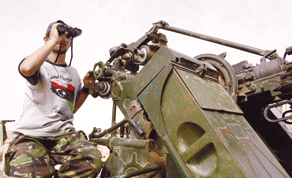
| A Libyan rebel fighter looks through a pair of binoculars on the outskirts of Gawalich near Zintan yesterday |
The diplomat said the informal proposals would be canvassed by the special UN envoy to Libya, Abdul Elah al-Khatib, who has met both government officials and rebels several times.
Khatib, a Jordanian senator, said in Amman he hoped both sides would accept his ideas.
“The UN is exerting very serious efforts to create a political process that has two pillars; one is an agreement on a ceasefire and simultaneously an agreement on setting up a mechanism to manage the transitional period,” he said.
He did not go into the details of that mechanism.
In public, the Libyan leader remained firm, telling supporters he would never countenance talks with the rebels who rose up in February to try to end his 41-year one-man rule.
“There will be no talks between me and them until Judgment Day,” Gaddafi told a crowd of thousands in his home town of Sirte in a remotely delivered audio message on Thursday.
“They need to talk with the Libyan people ... and they will respond to them.”
He has, however, said he welcomes talks with Western powers, with no preconditions. But Washington and Paris say they have given his officials the same simple message: Gaddafi must go.
Gaddafi has stepped up his defiant rhetoric amid persistent reports of talks. Pro-government rallies are being shown almost daily on state television, perhaps a reminder to outsiders that he can still command considerable support.
State television said Gaddafi would make another speech today, this time addressed to Egyptians on the anniversary of their revolution—not this year’s, which toppled president Hosni Mubarak, but pan-Arabist Gamal Abdel-Nasser’s in 1959.
The rebels seem unlikely to quickly unseat Gaddafi, who came to power himself as a young revolutionary influenced by Nasser, despite months of backing from Nato air strikes, authorised under a UN resolution to protect civilians.
Rebel foreign spokesman Ali Essawi said Mansour Daw, a key aide to Gaddafi, had been wounded in a rebel rocket attack on a meeting of Gaddafi’s inner circle in Tripoli on Thursday.
There was no government comment and the report could not be independently verified.
Analysts say a stalemate has led to intensified diplomatic overtures, with France saying for the first time this week that Gaddafi could stay in Libya as long as he gives up power.
Essawi, in Rome for talks with Italian Foreign Minister Franco Frattini, was asked if rebels might accept that.
“The first principle for Libyans is that Gaddafi should step down, and announce this and make this very clear. After that, we can talk about details,” he told reporters, but added:
“Negotiations will be only on the departure of Gaddafi. We will not negotiate on his staying in Libya or ruling the Libyans.”
The European diplomat, who declined to be named, said talks had yet to start on Khatib’s plan, which foresees an immediate transitional authority made up equally of government and rebels.
The authority would appoint a president, run the security forces and supervise a reconciliation process, leading to elections to an assembly which would write a constitution.
Gaddafi and his sons would be excluded from the authority since the rebels would never accept them, but his prime minister, for example, might have a role, the diplomat said.
Gaddafi would only accept a transition if his own fate were guaranteed, so he need not immediately be handed to the world court in The Hague which seeks his arrest over crimes against humanity allegedly committed by his forces, he added.