AFP/Tunis
A Tunis court yesterday sentenced ousted Tunisian president Zine al-Abidine Ben Ali in his absence to 15 years in jail for possession of arms, drugs and archaeological artefacts.

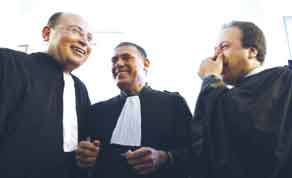
Hosni Beji, Abdessatar Massoudi and Bechir Mahfoudhi, attorneys representing Tunisia’s ousted president Zine al-Abidine Ben Ali, laugh in the courtroom in Tunis yesterday
In his second trial since fleeing to Saudi Arabia following a popular uprising in January, Ben Ali was also given a fine of 54,000 euros ($78,500).
The former strongman and his wife Leila Trabelsi had already been sentenced in absentia to 35 years in prison last month for misappropriating public funds after large sums of cash and jewellery were discovered in a police search of their palace.
In yesterday’s trial, Ben Ali alone was accused of harbouring drugs and weapons at his palace in the Carthage neighbourhood north of Tunis. He also faces a drug trafficking charge.
After fours hours of deliberation, the court sentenced him to 10 years for drug possession, five years for weapons possession and six months for possession of archaeological artefacts.
“Today’s trial, just like yesterday’s trial and the 93 other scheduled trials, is non-existent as it breaches all standards of a fair trial,” Ben Ali’s lawyers said in a statement read out even before the verdict was announced.
“Today’s trial is part of a political smear campaign against president Ben Ali which is aimed at portraying him as a drugs, weapons and currency smuggler.”
The trial had been scheduled to take place last week but was postponed due to a judges’ strike.
It opened with presiding judge Touhmi Hafi noting Ben Ali’s absence for the record, saying: “The accused is not present and is a fugitive.”
Ben Ali’s attorneys then pressed for another postponement to allow them more time to prepare their defence.
After their request was turned down, the lawyers stormed out, with Hosni Beji blasting what he called “the disregard for the rights of the defence”. Their exit triggered loud boos from the public.
“I am bitter. We did a good job. Our request for a delay is not a lawyer’s whim. This trial is tainted by irregularities,” Beji fumed.
“How can we imagine that a president holding power can have 2kg of cannabis resin of mediocre quality (with intentions) of selling it?” Beji asked, describing the charges as “irrational.”
Beji also said most of the weapons found at Ben Ali’s palace in the Carthage neighbourhood were personal gifts from high-ranking international figures, including Algerian President Abdulaziz Bouteflika and Saudi Interior Minister Prince Nayef bin Abdulaziz.
And Ben Ali has dismissed as a setup the discovery of the cannabis in his office after his departure.
After only six hours’ deliberation, a court on June 20 sentenced the Ben Ali couple to 35 years in prison for misappropriating public funds and also imposed a 45mn euro ($65.3mn) fine.
The former ruler and his wife have been living in exile since January 14, with Riyadh ignoring, at least publicly, Tunisian demands for their extradition.
Ben Ali denounced his June 20 conviction as a “parody of justice” and “political liquidation”, in a statement.
Dozens of spectators came to watch yesterday’s proceedings but there was no demonstration outside.
“It has become routine,” said one of the two policemen posted outside the courtroom.
In a sign of public indifference, newspapers gave minimal coverage to the trial.
“It mirrors what is going on in the country. Just more theatricals,” said 20-year-old Ali Ayouni.
Ayouni hails from Regueb, the town in the southwestern Sidi Bouzid province where the self-immolation of a street vendor sparked last December’s popular revolt that ultimately toppled Ben Ali and ignited a wave of mass uprisings elsewhere in the Arab world.
In addition to yesterday’s hearing, Ben Ali and his entourage face possible legal proceedings in no fewer than 182 other cases.
In one, a military court is expected to consider charges relating to the 300 people killed during the uprising.