


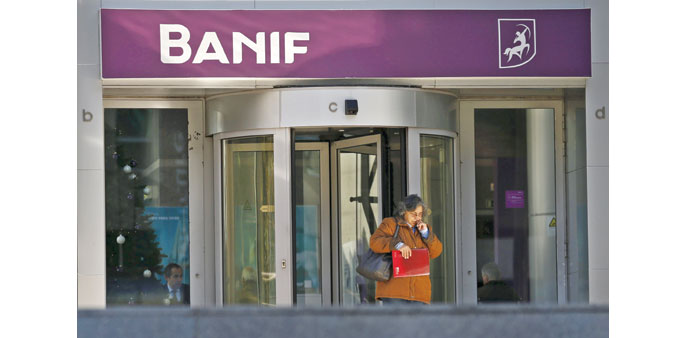
A woman leaves the headquarters of Portuguese bank Banco Internacional do Funchal (Banif) in Lisbon yesterday. The government-backed bailout of Banif comes less than two years after the state paid out €4.9bn to rescue the country’s then second largest bank Banco Espirito Santo.
Second bank rescue in less than two years; cabinet meeting to define budget impact; Left Bloc calls for central banker to resign; market reaction muted
Reuters
Lisbon
Portugal is to pay more than €2.2bn ($2.39bn) to rescue Banif in a deal which involves a sale of the Madeira-based bank’s healthy assets to Spain’s Santander for €150mn.
The government-backed bailout of Banif (Banco Internacional do Funchal) comes less than two years after the state paid out €4.9bn to rescue the country’s then second largest bank Banco Espirito Santo.
Banif had been unable to repay €700mn provided by the government during Portugal’s economic crisis. The state took a 60.5% stake in exchange for the cash and had been trying to sell Banif before new European rules come in on January1 which would impose losses on debt holders and depositors with more than €100,000 in the bank.
Prime Minister Antonio Costa, whose Socialist government took over earlier this month, said the costs of the resolution were “very high for taxpayers”, but this was the only solution to safeguard depositors and financial stability.
The cabinet was meeting yesterday to see how the costs would be reflected in this year’s budget and whether it might compromise Portugal’s efforts to cut its budget deficit below the EU threshold of 3%.
“This resolution is not a major systemic issue, but it does show how fragile the banking system and the economy still is in Portugal, where bad loans have been rising,” Nicholas Spiro, managing director at Spiro Sovereign Strategy in London, said.
Portugal’s Left Bloc party, which supports the minority Socialist government in parliament, accused the previous centre-right government of hiding Banif’s problems to avoid an impact on public accounts on its watch, and demanded the resignation of Bank of Portugal Governor Carlos Costa.
“The Bank of Portugal has once again failed to live up to its responsibilities. We believe that Gov. Carlos Costa does not have the minimum conditions to stay in his position,” Mariana Mortagua, a senior Left Bloc member of parliament. The party wants an investigative committee be set up in parliament.
No one was immediately available to comment at the Bank of Portugal.
The Bank of Portugal said earlier that the deal had been agreed with European authorities and involved an injection of €2.2bn “to cover future contingencies”. It said it would also protect Banif’s senior debt. Portugal’s Bank Resolution Fund, to which all financial institutions working in Portugal have to contribute, will provide €489mn, while the remaining nearly €1.77bn would come directly from state coffers.
Santander Totta, the Portuguese business of Santander, will take over all of Banif’s operations, except troubled assets which will be transferred to a special vehicle. The rest of Banif is to be wound down, including equity and subordinated debt.
Banif has a market capitalisation of €91mn and had deposits of €6bn at the end of September. Its shares were suspended last Thursday pending information about its sale. It has 150 branches across Portugal.
Markets reacted calmly. Portuguese government bond yields were slightly higher in line with European peers in response to a fragmented result in the Spanish national elections on Sunday.
Portuguese banking shares were mixed.