


DPA/Cairo
Dozens of protesters gathered late yesterday in front of the interior ministry in downtown Cairo, carrying signs and chanting against police torture on the first anniversary of the death of Khaled Said.

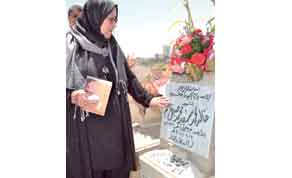
Layla Qasim, the mother of Khaled Said, who was allegedly beaten to death by policemen in 2010, visits his grave on the anniversary of his death in Alexandria yesterday
Said, 28, died in June 2010 after plainclothes policemen reportedly beat him in the northern coastal city of Alexandria, his family and activists say.
“Nothing has changed, the police officers haven’t been tried. Khaled has been denied the right to justice,” said Mohamed Effat, a 22-year-old protester.
The case against the two officers accused of beating Khaled Said has been repeatedly postponed.
Some activists suggest that the nationwide protests sparked by Said’s death in 2010 were crucial to building the momentum for the uprising which began on January 25 and led to former president Hosni Mubarak’s ouster.
Protesters chanted “The gang is the same, the interior ministry are still thugs!” and “The interior ministry is a basis for torture.”
Some of the protesters drew stencils of Said’s face on a wall of the ministry, in an act that would have been unthinkable before the uprising earlier this year.
“The revolution happened because of things like torture. The problem is there is no political will to change it,” Effat said.
“Mansour, it’s your turn,” protesters chanted, referring to Interior Minister Mansour el-Essawi, who was appointed after ousted president Hosni Mubarak’s resignation.
“The demands of the revolution haven’t been met yet, the corrupt institutions remain in place, and there are violations still occurring,” said Manal Khaled, a film director.
According to a Gallup poll published yesterday, Egyptians are less satisfied with their standard of living but feel more positive about the future.
“Egyptians expect a bright political and economic future and they envision a representative government where religious principles guide the democratic process, but with clerics limited to an advisory role,” said the report by Gallup-Abu Dhabi.
Around 1,000 Egyptians aged 15 and above took part in the poll in various parts of the country, between late March and early April.
Around 53% of those surveyed thought the economic conditions in their city were worsening, compared to 25% the same time last year.
Respondents were asked to predict where their life will be in five years’ time, using a scale of 1 to 10, with 1 representing the worst possible life and 10 the best.
“Egyptians forecast that, five years from now, their lives will be an average of 5.7 on the life evaluation scale, up from their 4.9 rating in the fall of 2010,” the report found.