


 |
|
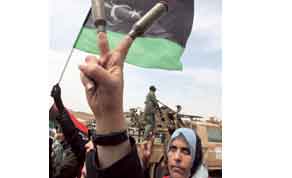
A Libyan woman makes the victory sign while holding up ammunition casings on her fingers, as rebel army officers teach a group of women the use of weapons in Benghazi yesterday |
The move by National Oil Corporation head Shokri Ghanem, who is also a former prime minister, came two days after the defections of eight army officers including five generals and those in earlier weeks of senior diplomats and other former ministers.
“I left the country and decided also to leave my job and to join the choice of Libyan youth to create a modern constitutional state respecting human rights and building a better future for all Libyans,” he said.
Speaking at a news conference in Rome organised by the Libyan ambassador, who has also defected, Ghanem said he had left his job because of the “unbearable” violence in Libya.
He said he still saw some possibility of a peaceful settlement to decide the fate of Gaddafi’s 41-year-old rule, which he said he had left because of the “daily spilling of blood” he had witnessed in Libya.
Ghanem, who is one of the most senior Libyan officials to have defected, said he supported “Libyan youth fighting for a constitutional state”.
Ghanem, whose whereabouts had been unknown for several days, also said oil production in Libya is coming to a halt because of the international embargo.
Now in its fourth month, the Libyan conflict is deadlocked, with rebels unable to break out of their strongholds and advance towards Tripoli, where Gaddafi appears to be firmly entrenched.
Rebels control the east of Libya around the city of Benghazi, the third-biggest city Misrata, and a mountain range stretching from the town of Zintan, 150km south of Tripoli, towards the border with Tunisia.
Nato said yesterday it had extended its Libyan mission for a further 90 days, after Gaddafi made it clear he would not step down, dashing hopes of a negotiated end to the uprising against his rule.
The 28-member alliance originally took over a campaign of air strikes, the enforcement of a no-fly zone and an arms embargo on Libya to protect rebellious civilians from attack by Gaddafi’s forces in late March for 90 days.
“Nato and partners have just decided to extend our mission for Libya for another 90 days,” Nato Secretary General Anders Fogh Rasmussen said in a statement. “This decision sends a clear message to the Gaddafi regime: We are determined to continue our operation to protect the people of Libya.”
South African President Jacob Zuma said on Tuesday after talks with the leader that Gaddafi had stated emphatically he would not leave Libya—making a negotiated end to the conflict impossible given rebel demands for his departure.
Zuma was in Tripoli on Monday to try to revive an African “road map” for ending the conflict, which started in February with an uprising against Gaddafi and has since turned into a war in which thousands of people have been killed.
A source in Misrata said the city was calmer early yesterday after a Reuters photographer reported heavy fighting in the suburb of Dafniyah, in the west of Misrata, on Tuesday.
A rebel spokesman in Zlitan, one of only three towns separating Misrata from Tripoli, said Gaddafi was arming criminals to crush a rebellion against his rule there.
The spokesman, Mohamed, said forces loyal to the Libyan leader were recruiting criminals whose task was to arrest anyone suspected of being a rebel and to intimidate residents.
“They filled it with drug dealers, criminals and other crooks,” Mohamed said by telephone. “They gave them automatic weapons and hand grenades to oppress the residents of Zlitan. Besides arrests and intimidations, we hear accounts of rape.”
In response to the allegations, an official for the Gaddafi government said: “These reports are completely false. There is nothing happening to that effect in Zlitan.”
Speaking from Nalut in the Western Mountains, rebel spokesman Kalefa said by telephone that revolutionary forces there had taken over the Shakshuk area near the city of Jadu after fighting in the early hours of yesterday.