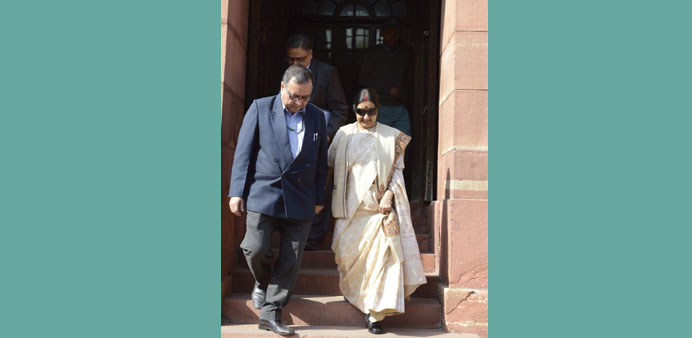
External Affairs Minister Sushma Swaraj is accompanied by an aide as she leaves parliament building after making a statement in both houses on her Pakistan visit.
Agencies/Islamabad/ New Delhi
Indian High Commissioner to Pakistan T C A Raghavan said yesterday his country was only prepared to discuss the part of Kashmir controlled by Islamabad in upcoming peace talks, presenting a potential stumbling block days after the dialogue was announced.
Raghavan made the remarks about the territory during a lecture in the Pakistani capital, after a breakthrough visit by India’s External Affairs Minister Sushma Swaraj at which the resumption of ministerial talks was announced.
According to a joint statement, the two sides will talk about peace and security as well as territorial disputes including Kashmir. Each country occupies part of the territory but claims it in full.
Asked where the room for negotiation lay over the territory, Raghavan said it was India which first petitioned the UN to intervene when the-then princely state of Jammu and Kashmir was invaded by Pakistani forces in 1947.
“The first application was moved by India and it was on the grounds that a part of the state, which had acceded to India, is now under the illegal occupation of the Pakistan army.
“So when you say what is it that India is going to discuss or what is it discussing, it is really, if you ask most Indians, and what is our position - it is the part of that state which is still under the control of Pakistan.”
The remarks could create a diplomatic wrinkle for the two countries as they seek to go back to the negotiation table to undertake broad-spectrum talks for the first time since the election of Prime Ministers Narendra Modi and Nawaz Sharif.
Badar Alam, editor of Pakistan’s political Herald magazine, said: “I think it is a step back,” adding that Kashmir was viewed internationally as a disputed territory.
He added that given the fragile state of the dialogue, officials on both sides needed to tread “very cautiously and very carefully” to avoid a backlash.
New Delhi suspended all talks after gunmen attacked Mumbai in November 2008, killing 166 people. The attacks were later found to have been planned from Pakistan. The countries agreed to resume the peace process in 2011 but tensions have spiked over the past two years, with cross-border shelling over Kashmir claiming dozens of lives since 2014.
A brief meeting between Sharif and Modi on the sidelines of the UN climate change summit in Paris on November 30, followed by talks between the two countries’ national security advisers in Bangkok, appeared to have broken the ice.
In New Delhi, Swaraj yesterday expressed the hope that renewed dialogue between the two countries will open a new chapter of peace and development in the region.
Making a statement on her visit to Pakistan in both houses of parliament, Swaraj said it was decided that a “Comprehensive Bilateral Dialogue” will start and foreign secretaries of the two countries will work out the modalities under the “new dialogue”.
“The new dialogue, we sincerely hope, marks a new beginning also for peace and development in the whole region,” she said.
Swaraj said India emphasised the need to speed up the judicial process in the Mumbai terror attack.
The minister said her meetings with Sharif and his Adviser on Foreign Affairs Sartaj Aziz in Islamabad were held against the backdrop of “positive developments” of the talks earlier between the two national security advisers in Bangkok.
“Both sides condemned terrorism and resolved to co-operate to eliminate this menace. There we dwelt on the need for Pakistan to expedite the Mumbai terrorist attack trial,” Swaraj said.
“The Indian side was assured of the steps being taken to expedite its early conclusion.”
“This government accords the highest priority to the country’s security. In order to meet the threats, the government will take all steps, including through diplomatic channels,” she added.
“At the same time, the government is also committed to building an environment of peaceful and co-operative relations with all our neighbours, including Pakistan, so that the efforts for peace and development in South Asia, initiated by the government on the day of assuming office itself, are taken further forward,” she said.