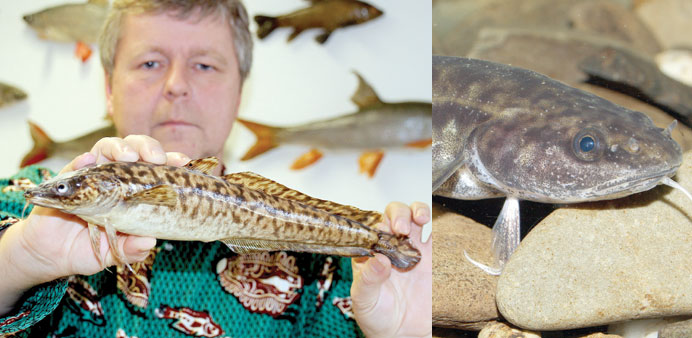
The head of the Arnsberg region fisheries department, Bernd Stemmer, holds a model of a burbot in his office.
By Joerg Taron
A rare species of fish, the burbot, is being promised a place in German conservation history if it can successfully repopulate what was once one of Europe’s filthiest waterways.
Flowing through the country’s industrial heartland, the 219-kilometre Ruhr River in the state of North Rhine Westphalia is the setting of a major test of ecological effort and conviction.
The Ruhr and its tributaries were like stinking open sewers in the 19th and early 20th centuries, ruined by the Ruhr’s coalfields, coking plants and armaments and chemical factories. The area provided the energy and steel to make Germany a global industrial and military power. The coalfields filled with homes and factories, and millions of people earned their livings amid the grime.
Nowadays, some of the heavy industry has gone, pollution rules are strict and 2,000 burbots, a relation of the cod, have been released into the clean waters of the upper Ruhr to see if they can acclimatise. The fish put in the water in November can grow up to half a metre long.
“The burbot (scientific name Lota lota) is probably North Rhine Westphalia’s rarest species,” says the Ruhr Water Authority, which is behind the repopulation attempt. But for all the enthusiasm and resources invested in the project, the burbots’ fate hangs in the balance.
The waters are becoming steadily cleaner, but they are also still a long way from being able to sustain a broad diversity of wildlife, say the state’s environment authorities.
Of the original 51 native fish species here, four are extinct, three are critically endangered and seven are vulnerable. So a number of programmes are under way to recreate their old habitat.
The results are promising. In the Lippe River, like the Ruhr also a tributary of the Rhine, a few hundred burbots were previously released and some were caught and successfully cultivated by local fisheries. “We have bred 5 to 6 million burbots annually since 2012,” said Michael Kuhlmann of the Ruhr Valley Authority. “And they have again colonised the Lippe and surrounding waterways.”
With this mass of offspring, it may be possible to also permanently introduce the burbot into other rivers. “The Ruhr is particularly suited for this because of good conditions in areas restored to their natural state,” says the head of the Arnsberg region fisheries department, Bernd Stemmer.
He gives the specimens let loose in the river a good chance to reach full growth. “But I’m as excited by the question of whether they can then multiply,” says Stemmer.
It will take another three or four years at least to find out. If the attempt succeeds, the presence of fish will also improve the water quality of the Ruhr. But Stemmer thinks the fish may only find the right conditions in a few places on the river: “It’s not only a matter of the chemical composition of the water, but also the presence of micro-organisms and other fish.”
There is still much catching up to do in restoring this once abundant breeding ground. Locks and dams as well as unshielded run-ins from hydropower turbines make rivers and streams hazardous and fish often can’t establish themselves, says Stemmer. But since water pollution is no longer the main problem, apart from in a few last places, the priority now is to naturally interconnect the separate waterways once again.
Meanwhile, some other fish species are now thriving. This summer, the state’s Environment Ministry said that since its reintroduction into the Rhine in 2007, the allis shad, a migratory Atlantic species of herring, had settled again in Germany’s greatest river after decades of absence.
At a former drainage channel of the Ruhr area, the Emscher River, people have witnessed a near miraculous change.
“When I studied there in the 1980s, the Emscher was a dangerous, fetid canal that was blocked off,” says Stemmer. Now it is recognisable as a river again and hosts sticklebacks and other species not seen here for a century.
“I was especially happy to find a brook trout in the Emscher two weeks ago,” says the conservationist. “It’s wonderful to see a cesspool become a real natural habitat again.” —DPA