AFP/Washington
Key global players yesterday backed US President Barack Obama’s call for a Palestinian state including land lost in the 1967 war as Israel insisted there could be no return to “indefensible” borders.

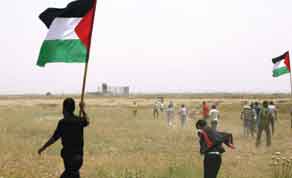
Palestinian youths wave their national flag during a protest yesterday near the town of Khan Younis, close to the border between Israel and the southern Gaza Strip
As Obama’s vision was welcomed by the European Union, the UN, Russia, the Palestinians and parts of the Arab world, Israeli Prime Minister Benjamin Netanyahu bluntly rejected it as “unrealistic”.
This prompted Palestinian leader Mahmoud Abbas to urge Obama to press Netanyahu to accept a Palestinian state based on 1967 borders.
“We call on President Obama and the Mideast Quartet to pressure Netanyahu to accept the 1967 borders,” Abbas’ spokesman Nabil Abu Rudeina said in Ramallah.
“Netanyahu’s position is an official rejection of Mr Obama’s initiative, of international legitimacy and of international law.”
The diplomatic Quartet on the Middle East, which includes the European Union, the UN, the US and Russia, expressed “strong support” for Obama’s statement that a Palestinian state should include land that Israel has occupied since the 1967 war.
“The Quartet agrees that moving forward on the basis of territory and security provides a foundation for Israelis and Palestinians to reach a final resolution of the conflict through serious and substantive negotiations and mutual agreement on all core issues,” it said.
“The Quartet reiterates its strong appeal to the parties to overcome the current obstacles and resume direct bilateral negotiations without delay or preconditions.”
EU foreign policy chief Catherine Ashton “warmly welcomes President Obama’s confirmation that the borders of Israel and Palestine should be based on the 1967 lines,” a spokeswoman said.
German Chancellor Angela Merkel said Obama’s speech was “a very important message for the Middle East peace process” and the proposal “a good path that both sides should consider”.
In London, British Foreign Secretary William Hague said he supported Obama’s “clear message that the borders of Israel and Palestine should be based on the 1967 lines with mutually agreed swaps.”
“The scale of the challenge is unprecedented and our response must match the aspirations of people across the region,” he said as France, Sweden and Poland also backed Obama’s statement.
In the Arab world, Jordan hailed the American president who it said “for the first time clearly spoke of his vision for the establishment of a Palestinian state based on 1967 borders and which must enjoy autonomy.”
Lebanese prime minister-designate Najib Mikati said Obama’s speech made no mention of Palestinian refugees’ right to return—a key concern for his country which is estimated to host up to 400,000 Palestinian refugees.