


 |
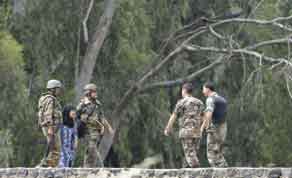
| Syrian soldiers hand over an elderly Syrian woman to Lebanese army troops as she was found trying to cross the border into northern Lebanon on foot on a bridge which links the Syrian side of the border village of Arida to Lebanon yesterday. The family of the woman who lives in the Syrian village of Arida had already fled their homes for fear of fresh violence as a result of anti-regime protests in their country, leaving her behind |
Looking across the border from the Lebanese village of Boqaya, Syrian soldiers could be seen deploying along a stream in Arida village and entering homes. Lebanese soldiers fanned out on their side of the frontier.
Earlier, sporadic gunfire and shelling were heard from the village. Arida is near the mostly Sunni Muslim town of Tel Kelakh, where one rights activist says Syrian troops have killed at least 27 civilians since entering it on Saturday.
Yesterday a resident said that armoured personnel carriers and dozens of buses filled with soldiers had begun pulling out of Tel Kelakh around noon and were heading north.
“The army is largely gone. There are no security police on the streets, but they are still in and around their headquarters away from the centre of Tel Kelakh and they are still occupying the main hospital,” the witness said.
Syrian security forces have used tanks, gunfire and mass arrests to crack down on flashpoints in an attempt to crush a two-month-old revolt against four decades of authoritarian rule by the Assad family. Bashar himself has ruled for 11 years.
Western powers, fearing instability across the Middle East if Syria underwent a dramatic upheaval, at first made only muted criticisms of Assad’s actions, but then stepped up their condemnation and imposed sanctions on leading Syrian figures.
Washington’s decision to target Assad personally raises the question of whether the West will seek his overthrow.
Damascus condemned the sanctions, saying they targeted the Syrian people and served Israel’s interests.
“The sanctions have not and will not affect Syria’s independent will,” an official source was quoted as saying on state television.
“Any act of aggression against Syria is an American contribution to Israeli aggression against Syria and Arabs.”
A senior US official said the new sanctions were meant to force Assad to carry out promised political reforms.
“President Assad has a clear choice: either to lead this transition to democracy or to leave,” the official, speaking on condition of anonymity, told reporters.
Leading Syrian opposition figure Haitham al-Maleh said the decision meant “members of the regime are now under siege”.
The US Treasury Department said it would freeze any assets owned by Syrian officials that fell within US jurisdiction, and bar US individuals and companies from dealing with them.
The sanctions also include Syria’s vice president, prime minister, interior and defence ministers, the head of military intelligence and director of the political security branch, but it was unclear which assets, if any, would be blocked.
An EU diplomat said the European Union was also likely to extend its sanctions on Syria next week to include Assad.
The unrest in Syria began in March when protesters, inspired by uprisings in other parts of the Arab world, took to the streets calling for greater freedoms and an end to corruption.
Assad made token gestures towards reforms, including lifting a decades-old emergency law, but the crackdown by troops, security forces and irregular Assad loyalists intensified.
In a possible indication of the crackdown’s ferocity, villagers near the southern city of Deraa said earlier this week they had found separate graves containing up to 26 bodies, allegations denied by Syrian authorities.