


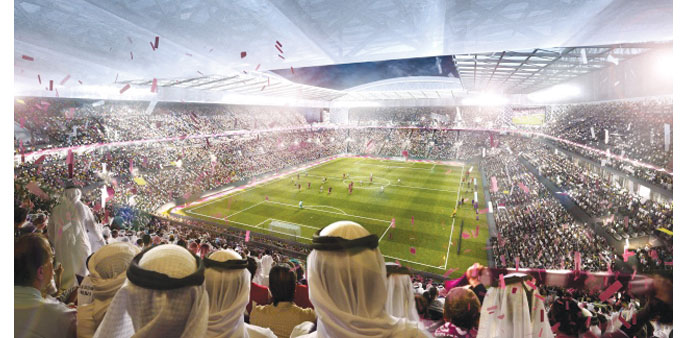
Inclusivity for disabled people in the 2022 World Cup is in line with the human and social development indices defined by Qatar National Vision 2030 and FIFA guidelines. All six stadiums in various stages of construction have detailed access plans for disabled people built into their designs. And so will all other stadiums which will be venues for the 2022 FIFA World Cup Qatar.
By Sports Reporter/Doha
As stadium construction continues to progress, so does the planning for accessibility for these venues. The Supreme Committee of Delivery & Legacy (SC) is making sure to provide a fully inclusive tournament.
Building stadiums with access to disabled people will add a layer of inclusivity to the first FIFA World Cup in the Middle East.
All six stadiums in various stages of construction—Al Bayt Stadium in Al Khor City, Al Wakrah Stadium, Al Rayyan Stadium, QF Stadium, Khalifa International Stadium and Lusail Stadium—have detailed access plans for disabled people built into their designs. And so will all other stadiums which will be venues for the 2022 FIFA World Cup Qatar.
Inclusivity for disabled people in the 2022 World Cup is in line with the human and social development indices defined by Qatar National Vision 2030 and FIFA guidelines.
“It is important that all stadium venues have included access plans for disabled people in their design,” Mark Dyer, Accessibility and Inclusive Design Adviser of the SC, said.
“We need to implement the process with great degree of detail so that all disabled people, whether they be from Qatar or visiting fans, truly have a wonderful fan experience during the first World Cup in the Middle East.”
Dyer stated that the stadium experience is not the only way of ensuring a truly inclusive World Cup for the disabled people.
“We will need to lay out elaborate plans for fans at all stages: The journey from the airport to the hotels, the nature of support in the hotels and their accommodation and the journey from there to the stadiums and back, and even in fan zones and other public areas and malls.”
He added: “It is wonderful that Qatar Rail also have included access of disabled people into their plans.
“And we’ll need to devise a system wherein all forms of public transport are inclusive and take on board the access of disabled people.
“We have made a good beginning and we need to work hard in the next seven years to make this a reality.”
The primary challenge, according to Dyer, is to get across the voice of disabled people to policy makers as well as professionals involved in the construction of stadiums and public infrastructure.
“We cannot afford to sit on our laurels and hope that the design has incorporated the needs of disabled people. At every stage, we need to ensure that the policy makers and professionals who implement the policies take on board the voices of disabled people living in Qatar,” he said.
The SC has taken this on board as a priority and the SC Community Engagement team is setting up a special accessibility forum for disabled people. Scheduled to be operational in the first quarter of 2016, the forum will include representatives from disabled people in Qatar as well as from institutions in the country representing disabled people and will meet designated SC professionals and technical teams two times annually.
Through the SC, the forum will also engage with ministries and technical stakeholders delivering projects that will directly impact the World Cup experience—primarily the Ministry of Transportation, the Ministry of Interior and the Qatar Tourism Authority.