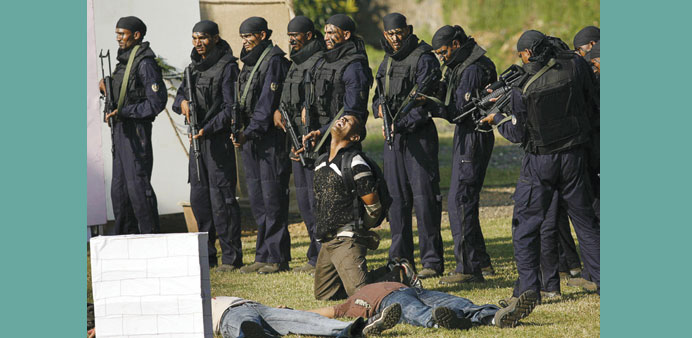
Members of the Force One Commandos from Maharashtra police demonstrate their skills during their inauguration ceremony in Mumbai in this November 24, 2009 file photo.
Reuters/Mumbai/ New Delhi
Last month, during an exercise to test India’s readiness for a militant attack, teams of coast guards approached Mumbai and surrounding areas by sea, just as assailants did before deadly strikes in 2008. Several teams slipped through undetected.
Officials say the response to the mock assault in Maharashtra was not a disaster, but the shortcomings it exposed were a reminder of India’s vulnerability to the kind of violence that hit Mumbai seven years ago, when 166 people were killed, and Paris only last month.
“There was a mixed result,” said a navy spokesman in Mumbai, describing the mid-November exercise that, by coincidence, came days after gunmen targeted Paris on November 13, killing 130.
“We do find weaknesses, but over the years the number of people who can go through (our defences) is much less.”
The atrocity in France drew immediate comparisons with events in Mumbai on November 26, in 2008, when 10 gunmen landed on the city’s shores by boat, split into pairs and attacked various high-profile sites using semi-automatic weapons.
In response, Mumbai police got better equipment, and a unit of the National Security Guard (NSG) was deployed to the financial capital. Fishermen have been made aware of the seaborne threat and can call a helpline if they spot anything suspicious.
Maharashtra also set up its own elite counter-terrorism police unit: Force One.
But the initial zeal with which the threat was treated has faded, security experts said.
“A lot of effort goes in at first. But over time, people lose interest. Momentum is lost. There is no leadership continuity,” said Govind Sisodia, a senior commander of the NSG at the time of the Mumbai raid.
Sisodia, now retired, was unable to scramble his elite force from its headquarters in New Delhi for 12 hours after the start of the Mumbai attack because no plane could be found.
Poorly armed, trained and equipped police first-responders were no match for the heavily armed gunmen who simultaneously attacked multiple targets. The drama evolved into a hostage crisis that dragged on for three days.
Seven years after 26/11, Force One has yet to move into its promised purpose-built headquarters outside the city.
For now, it protects one of the world’s largest metropolitan areas from a modest office on the fourth floor of a shabby low-rise building which it shares with a police academy. Lines of drying laundry hang from the windows.
“From every incident, we take a lesson, we revise our protocols,” said Sanjay Saxena, the inspector general of police running the unit, when asked about the Paris attack.
Saxena gave little away about how his squad operated, including how he might scramble his hand-picked team from a northern suburb to districts in Mumbai’s historic south along the city’s jammed roads.
Some of the commandos in Force One, modelled on Germany’s GSG 9 special forces, are allowed to live at home. According to some officials, the 600-strong force trains on a police parade ground.
A critical worry, say security experts, is that tactics used by militants are evolving.
While the attack on Paris echoed elements of that in Mumbai, it also differed, for example in the use of suicide belts to maximise casualties and rule out capture.