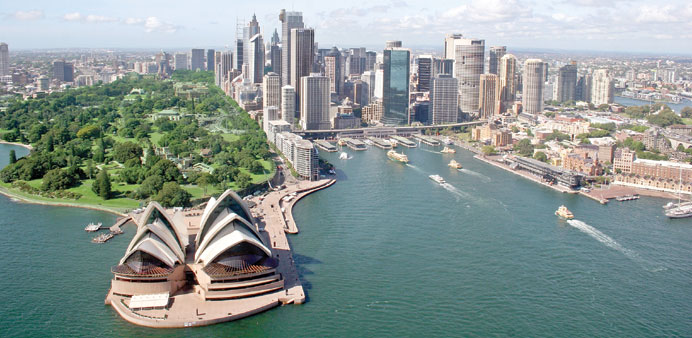
SUMMER TIME: An aerial view of the Sydney skyline from the north. File photo by Beau Giles
By Steff Gaulter
It’s been horribly hot in Australia. On November 20, Sydney sweltered through its second hottest November day on record. The temperature soared to 40.9 C (105.6 F), but that’s really only half of the story.
At 7am on that Friday, when residents around the city were waking up, the temperature was a pleasant 22C (72F). With cloudy skies and a fairly high humidity of 85%, it was a fairly non-descript start to the day. In fact, I would imagine that a number of people who had seen the day’s forecast predicting the horrifically high temperatures didn’t believe a word of it.
As the morning wore on, the temperature climbed steadily, but not rapidly enough to achieve an exceptional reading. A sea breeze had developed and this was keeping the heat at bay. Eventually, at approximately 1:30pm, the sea breeze finally succumbed to the ferocious westerly winds. These westerly winds drew in air from the Australian interior.
Air generally takes on the characteristics of the region from where it came. If the air travelled over the sea, it will have picked up moisture, and often deliver cloud or rain when it reaches land. If it moved from across the land, it is usually dry, and if that land IS hot, then so will be the wind. At this time of year, the Australian interior is a hot, dry and dusty place. Therefore the winds were also hot, dry and dusty too.
As the winds swung round to blow from the west, they picked up. The winds gusted up to 70 kph (45 mph), forcing their way through the streets of the city. The change in weather was almost instantaneous. Within twenty minutes, the temperatures at Sydney Harbour shot up by 14 C (25F), and as the temperature rose the humidity dropped like a stone. At 1pm, the humidity was 46%, but by 2pm, it was just 4%.
Those of us who have endured a Qatari summer would know the difference humidity makes to the feel of the weather. A humidity of 4% is incredibly dry. Moisture evaporates into the air so rapidly that if you open your mouth and breathe in, it can almost feel like you have an ice cube in your mouth.
Fortunately for those who live in Sydney, dry air is easier to cope with than humid air. If the air is dry, then water can easily evaporate into it. This means that your sweat will evaporate from your skin, enabling your body to regulate its temperature.
The official temperature in Sydney, which is taken at Observatory Hill in the centre of the city, reached 40.9 C. The only time that the temperature has climbed higher than that in the month of November, was in 1982 when the temperature in the city soared to 41.8 C (107.2 F).
This year, as the temperature at Observatory Hill reached 40.9 C, other parts of the city recorded even higher temperatures; the airport’s temperature soared to nearly 43 C (109F). As the temperature shot up, people turned on their fans and air conditioners. This led to a huge peak in the demand of power and the electricity network wasn’t able to cope. Thousands of people lost power, just when they needed it most.
In Qatar, most of us have had to endure a little bit more of the summer heat than we would have liked. Either we had to park our car further away from a building than usual, or our taxi didn’t turn up on time, but by and large we can avoid being outside for long periods. In Sydney, however, the city isn’t prepared for such extreme temperatures. People walk to catch the bus, walk to restaurants and generally spend more time outside. A sudden blast of hot air, causing the temperature to soar over 40C will make the daily life more difficult in Sydney than it is for most of us in Doha.
Not only is it impossible for the residents to avoid being outside, it’s also impossible for them to acclimatise. The day before, the temperature had been just 34 C (93 F), and just two days before that, the maximum temperature had only been 26 C (79 F). This sudden spike in temperature would have not only taken its toll on the residents, but also the local wildlife.
Those living in Sydney should at least be thankful that the forecast was accurate. This allowed them to prepare for the heat, to stock up on water and ice, and make plans to avoid going outdoors as much as possible. There was also a ban on campfires in many of the National Parks, which helped to avoid a major outbreak of wildfires.
There was also another reason for Sydney-siders to be thankful: unlike the summer heat in Qatar, the hot blast was short-lived. In the evening, the furnace was abruptly extinguished. At 7:30pm the temperature was 35C, but just half an hour later, it was 25C, and the humidity had returned as well. In fact, as the residents went to bed that night, the weather was really quite pleasant, and they could almost imagine that the whole hot day had never really happened.