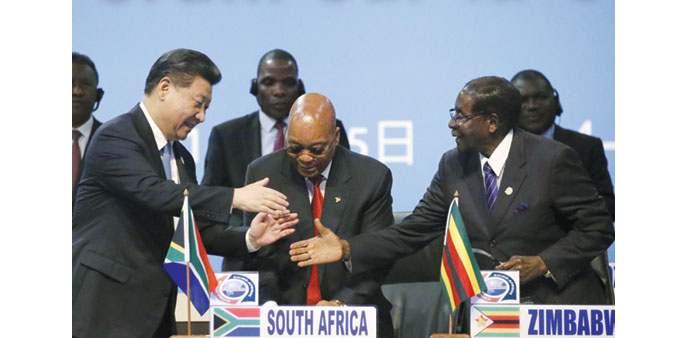
Xi reaches to shake Mugabe’s hand during the Forum on China-Africa Co-operation in Sandton, Johannesburg. With them is Zuma.
AFP/Reuters
Johannesburg
Chinese President Xi Jinping announced $60bn of assistance and loans for Africa at a summit in Johannesburg yesterday, signalling China’s commitment to the continent despite a recent fall in investment.
China’s economic growth has taken a dip this year, triggering a global commodities slump and causing Beijing to slash investment in Africa by more than 40% in the first six months of 2015.
Xi said that China would “provide a total of $60bn of funding support that includes $5bn of grants in zero interest loans (and) $35bn in preferential facility and export credit loans and concessional loans”.
In a slew of pledges at his speech opening the Forum on China-Africa Co-operation (FOCAC), he also announced drought aid for the continent.
“China is greatly concerned about the poor harvest caused by El Nino in many African countries and will provide 1bn renminbi yuan ($156mn) worth of emergency food aid to the affected countries,” he said.
The two-day FOCAC meeting is the second time China has brought together African leaders since the forum was launched in Beijing in 2000.
Since then, China’s trade with Africa has overtaken that of the traditional partners, Europe and the United States.
“China is still very active in Africa,” Deborah Brautigan, of the US-based China Africa Research Institute, told AFP. “They are very competitive. They made it clear that Africa is still their business partner (but) this big sum is mainly loans that will have to be repaid.”
The money will target 10 areas, including industrialisation, infrastructure, financial services, poverty reduction, and peace and security.
Zhong Jinahua, a Chinese diplomat at the summit, brushed off concerns about the recent drop in investment into Africa.
“I don’t think we need to panic over the fluctuation in trade volumes,” he said. “It’s only natural for the market to experience some ups and downs.”
A fall in mineral prices has hit African countries who relied on Chinese demand, with large lay-offs by mining companies in resource-rich countries such as Zambia and South Africa.
“We are keen to explore co-operation with China to ensure the long term viability of African mining,” South Africa President Jacob Zuma told the summit. “This is important in light of the declining demand for commodities.”
One Western diplomat struck a sceptical note about Xi’s announcement, saying: “It is difficult to tell what the deals involve beyond the headlines. Most of it is loans but it’s not clear if these are old or new deals.”
Xi also said China would not interfere in African countries’ internal affairs, a stance that drew applause from leaders such as Zimbabwe’s Robert Mugabe who have faced Western criticism of their human rights record.
He said: “China strongly believes Africa belongs to the African people and African problems should be handled by the African people.”
But China too has irked some Africans in the past for using Chinese firms and labour to build state-funded roads and railways in Africa while buying up commodities and leaving little for local economies, an image Xi is keen to change during the conference that ends today.
Among the presidents attending were Muhammadu Buhari of Nigeria, which is Africa’s largest economy, Salva Kiir of South Sudan, Joseph Kabila of the Democratic Republic of the Congo and Kenya’s Uhuru Kenyatta.
Xi – accompanied by his wife Peng Liyuan – landed in South Africa after a brief visit to Zimbabwe, where Chinese projects have helped prop up an economy plunged into crisis under Mugabe’s rule.
Mugabe, who addressed the summit’s opening session as chair of African Union, lavished praise on the Chinese leader.
“We say he is a god-sent person,” Mugabe said. “President Xi Jinping has made a much anticipated announcement of new measures ... to inject vibrancy into that already dynamic relationship between China and Africa.
“Our detractors have sought to portray our relationship to purely commercials ties, driven by China’s desire to extract our mineral resources, (but) our relations go much deeper.”
“Here is a man (Xi) representing a country once called poor. A country which never was our coloniser ... he is doing to us what we expected those who colonised us yesterday to do,” said Mugabe.
Sudanese leader Omar al-Bashir, who is wanted by the International Criminal Court (ICC) on charges of genocide, war crimes, and crimes against humanity, was not expected to attend the Johannesburg event.
He attended an African Union summit in the city earlier this year, leading to a huge furore when South Africa declined to arrest him despite a court order.