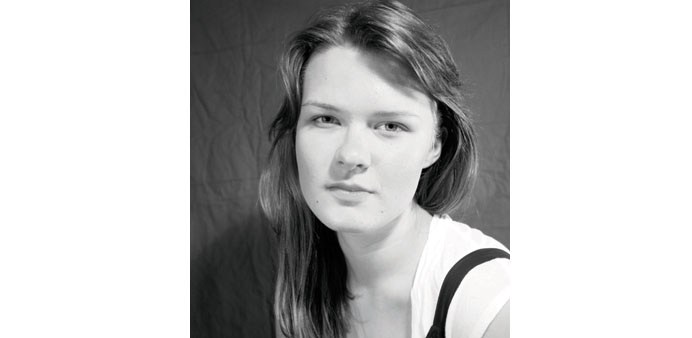
OVERWHELMED: “Our whole crew was changed by the experience of working on the film,” says Sofia Geweiler./INTERVIEW: Sofia Geweiler, Russian film director
By Anand Holla
The boundless strength of the human resolve continues to surprise us through the rare stories of staggering perseverance. However, in the never-back-down world of Paralympic athletes, such stories are the norm.
Young Russian director Sofia Geweiler’s spectacular ode to the human will, Spirit in Motion was arguably the most inspiring film at the recently concluded Al Jazeera International Documentary Film Festival in Doha.
The “Official Documentary for the Sochi 2014 Paralympic Winter Games” takes us through the lives of eight of the strongest athletes from across the world, who are fighting for the chance to come to Sochi and win a medal of the highest honour. Their toughest challenge, however, isn’t that of defeating any of their opponents — it is to defeat an opponent that lives with them, their own disability.
Slickly shot, the documentary stories of the athletes are at times, tossed with animated clips done in various styles, so as to lend a larger-than-life feel to these remarkable characters. Each of the film’s heroes — athletes from Australia, Brazil, China, Germany, Russia, and USA — represents one of six Paralympic sports — biathlon, cross-country skiing, alpine skiing, sledge hockey, wheelchair curling and para-snowboarding. The 73-minute-long film traverses many languages such as Portuguese, Chinese, English, German, and Russian; all with English subtitles.
Spirit in Motion isn’t just about sports, it’s a portrait of a moment in the world, Geweiler tells Community. “I worked on this film with my co-directors Yulia Bivsheva and Sofia Kucher. We were all in the same class,” says the 25-year-old, who graduated from the prestigious VGIK, Gerasimov Institute of Cinematography film school in Moscow. “The research took us three months. The idea was to chart a map of the modern world through interesting stories. We tried to find simple but touching stories that would fit this idea.”
The phrase Spirit in Motion happens to be the official motto of the Paralympic movement. The filming went on during the XI Sochi 2014 Paralympic Winter Games — using five cameras to shoot the action — as well as in the year preceding the start of the event at various countries, to capture moving portraits of the finest Paralympians in preparation for the big day.
“Our whole crew was changed by the experience of working on the film,” says Geweiler, “These athletes are mentally so strong and they possess tremendous will-power. It was very emotional for me to make this documentary.”
That’s understandable. Each of the stories are deeply affecting and exhilarating. German biathlonist Vivian Hoesch, who is born visually impaired, follows her guide along the track and shoots from a laser rifle, aiming with the help of sound. Australian Jason Sauer, whose drug overdose led to the amputation of both legs on a Christmas night, is now a master alpine ski racer. Ace sledge hockey player from American national team, Rico Roman, who lost his left leg after he ran into explosive device during his military service in Iraq, emerges a champion at the Games.
Roman’s teammate Alexis Salamone was born with twisted limbs due to the radiation that followed the Chernobyl nuclear power plant disaster. Adopted at the age of six by a family from the USA, Salamone shaped himself into a marvellous para-athlete.
Du Haitao, cross-country ski racer of the Chinese national team underwent amputation of both hands from shoulders at the tender age of five “under domestic conditions without anaesthesia,” after his childlike curiosity coaxed him into touching an electric transformer. Haitao, like the rest, didn’t give up, and skis using only his legs.
For Andre Cintra, the first sportsman in history who represented Brazil in Paralympic Winter Games para-snowboarder, tragedy befell in a pair. At 16, Cintra underwent a leg amputation following a motorcycle accident, and also lost both his parents. Emerging as a loving guardian of both his younger brother and sister, Cintra dropped out of school to launch his own successful cosmetics business, apart from, of course, shining in para-snowboarding.
Bound to their wheelchairs, Russian sportsmen Oksana Slesarenko, who lost her limbs to a car accident, and the captain of the team Andrey Smirnov, who while playing with his friends fell into a deep pit of a desolate house at the age of 12, are the superstars of wheelchair curling. The coincidence was such that the couple became disabled in the same year and in the same month, and were being treated in the same hospital, and yet they got to know each other many years later. In 2003, they created the first Russian wheelchair curling team. Last year, they won their country a medal in the sport.
Geweiler says the Sochi Games were very important for her and her crew because it was the first ever Paralympics for Russia as hosts. “Before the Paralympic games started, the International Paralympic Committee became interested in the film, watched the material and made the decision to assign the film the status of the first official film of the Paralympic Games. This is the first time that’s happened in the more than 50-year history of the Paralympic movement,” she says.
With such touching resonance, the film has picked up quite a few awards in its international festival run thus far, such as people’s choice award in Docs DF (Mexico), and the 2015 President’s Award for Young Artists for humanism ideals’ triumph in documentary film about Paralympic games Spirit in Motion (Russia).
“Until I made this film, I thought ‘Everything is possible’ is nice for a slogan, but perhaps not meant to fit in reality. But after this experience, I understood that for these people, ‘Everything is possible’ is a reality and they live this reality. I think they are amazing ambassadors of this thought,” she says.
For Geweiler, the journey of creating her first film hasn’t changed her much as a filmmaker, but has significantly changed her as a person. “Now when I feel lazy about something, I start thinking about the characters of this film,” she says, “For me, it’s very important that not only the athletes are taking part in fighting such odds, but also their family, relatives and close friends. That’s a terrific example of how people can help each other.”
She even wonders whether Rico could have been a sportstar in the US if his wife wouldn’t have helped or supported him as much as she has been. “Vivian Hoesch, who has been blind from birth, works in a call centre. It’s people in her town who decided that they have a blind person in their midst who is educated and has extraordinary determination to work,” she says.
Soon, they bought her a computer and it’s this decision that they made for her, made things better, feels Geweiler. “Such instances have made me realise that we can change the world around us by ourselves. And each one of us can do that,” she says.