


 |
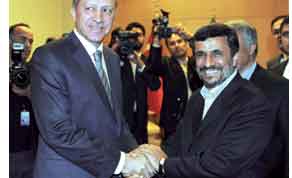
| Iran’s President Mahmoud Ahmadinejad shakes hands with Turkey’s Prime Minister Recep Tayyip Erdogan in Istanbul yesterday |
“I hope that this important issue will reach its final result in the (next) Istanbul talks,” Ahmadinejad told a news conference in Istanbul, broadcast live on Iranian state television, without giving a date.
Iran’s nuclear talks with major powers in January failed after it refused to halt uranium enrichment, as demanded by the UN Security Council.
The US and its European allies fear Iran is trying to build atomic bombs under cover of its nuclear programme. Tehran denies it, saying it needs nuclear technology to generate electricity.
After talks with his European Union counterpart in Geneva in February, Iranian Foreign Minister Ali Akbar Salehi said he hoped there would be further meetings, but no date was set.
Iranian media quoted Salehi as saying earlier this month that Tehran had received a letter from European Union foreign policy chief Catherine Ashton, who represented major powers in previous talks with Iran.
“Soon the response to Mrs Ashton’s letter will be sent by relevant Iranian officials,” Ahmadinejad said.
“We have always been in favour of talks. Iran is ready today to hold talks based on justice and mutual respect,” he added.
Washington said it could not confirm Ahmadinejad’s announcement.
“Obviously it has been some time since our last P5+1 talks. We’ve been quite clear on what we are looking for. But we do support this dialogue, and as we’ve said often there’s two tracks here and the door does remain open,” State Department spokesman Mark Toner told a news briefing.
After the last round of talks, which also took place in Istanbul, Ashton called the nuclear discussions with Iran disappointing, saying no further meetings were scheduled.
Iran has been hit by international sanctions for refusing to halt its sensitive nuclear activities. Ahmadinejad said Iran had no intention of stopping its nuclear work.
“Our nuclear activities are legal ... and under the supervision of the International Atomic Energy Agency,” he said in Istanbul, where he attended the conference of “least-developed countries”.
l Iran is conducting final tests at its first nuclear power plant and it is expected to start generating electricity in the next two months, Iranian media said yesterday.
Meant to be the first of a network of nuclear power stations Iran says it is planning, the Russian-built Bushehr complex has missed deadline after deadline to come on stream. Most recently, fuel had to be removed and checked for technical problems.
Fars news agency said Bushehr would start injecting power into the national electricity grid in the next two months.
“Right now, after the fuel rods that were unloaded from the reactor core were washed, they are being loaded again and final tests are under way,” Gholamali Miglinejad, a member of a parliamentary committee monitoring Bushehr, was quoted as saying by the student news agency Isna.
Iran began loading fuel into Bushehr last August in front of foreign and domestic media, touting it as a symbol of resistance to the international sanctions.
At that time, Iranian officials said it would take two to three months for Bushehr to start producing power, and that it would generate 1,000 megawatts, about 2.5% of Iran’s electricity usage. Russia is providing the fuel for Bushehr.
But the start-up of the plant has been hit by several delays since then, with some analysts blaming the mysterious Stuxnet computer virus. Tehran said Stuxnet had afflicted staff computers at Bushehr but not affected major systems there.
Security experts say the computer worm may have been a state-sponsored attack on Iran’s nuclear programme and have originated in the US or Israel. Neither country has mentioned any link with Stuxnet.
Some analysts believe Iran may be suffering wider sabotage aimed at slowing its nuclear advances, pointing to a series of unexplained technical glitches that have cut the number of working centrifuges at its Natanz uranium enrichment plant.