AFP/Damascus
At least 62 people died in clashes in Syria yesterday when tens of thousands of protesters marked a “day of rage,” activists said.

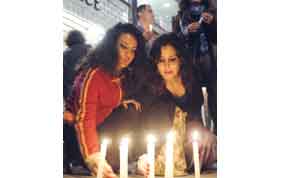
Lebanese and Syrian activists light candles to commemorate the victims killed during the unrest in Syria, at Hamra Street in Beirut yesterday
Syrian authorities said nine members of the security forces were killed at the hands of “terrorist groups.”
Pro-democracy protests were held against President Bashar al-Assad’s regime in most cities and major towns after weekly prayers, as on past Fridays since last month, witnesses said.
At least 33 civilians were killed in and around the protest epicentre of Daraa, the London-based Syrian Observatory for Human Rights said in Nicosia, adding it had a list of names of those confirmed killed.
Military officials said five soldiers were also killed and two captured by “armed terrorists” in the Daraa region of southern Syria.
And 27 civilians were killed in and around the industrial city of Homs, north of Damascus, the Observatory said, and two more in the Mediterranean port city of Latakia.
A military spokesman said one of the troops killed was a victim of “armed terrorists” who raided the family homes of soldiers in villages around Daraa. Dozens of assailants were killed and wounded, and 156 arrested, he said.
Three soldiers were killed when “another terrorist group” tried to cut off the main highway linking the cities of Homs and Hama, north of Damascus, the spokesman said, quoted by the state news agency Sana.
A policeman in Daraa was also among the dead.
Ahead of yesterday’s bloodshed, dissidents said security forces using live rounds and teargas already killed more than 450 people since the pro-democracy protests erupted in mid-March.
The call for mass demonstrations was issued on a Facebook page, The Syrian Revolution 2011, a motor of the protests in which demonstrators inspired by uprisings across the Arab world are seeking greater freedoms.
Assad’s embattled regime reiterated its running ban on demonstrations, despite having lifted a decades-old law barring them earlier this month, as the Muslim Brotherhood accused it of genocide.
Information Minister Adnan Mahmoud said the crackdown would continue, saying the “authorities are determined to restore security, stability and peace to the citizens”.
The interior ministry appealed to Syrians not to join the protests and warned that unauthorised rallies would not be tolerated.
It called on “brother citizens to contribute in an effective way to stability and security... by not staging demonstrations or sit-ins for any reason without official permission,” it said, quoted by Sana.
“The laws in force in Syria will be applied to preserve the security of citizens and the country’s stability,” it added.
Similar protests after weekly prayers on April 22 ended in chaos, with more than 100 people killed when security forces fired on demonstrators with teargas and live rounds. Hundreds of others were detained.
In Banias, about 10,000 people turned out yesterday, shouting “liberty, solidarity with Daraa” and “down with the regime.”
In Deir Ez-Zor, northeast of the capital, two demonstrators were beaten with batons and electrical cables after 1,000 people emerged from a mosque and were dispersed by security forces, rights activist Nawwaf al-Bashir said.
Some 15,000 people turned out in the majority Kurdish city of Qamishli and neighbouring towns, shouting “national unity” and “with our soul and with our blood we will sacrifice ourselves for Daraa,” activists said.
And besides Homs, where thousands of people could be seen shouting “down with the regime” on videos fed to the Internet, demonstrations were also staged in Saqba and Midan, near the capital.
In Daraa itself, security forces opened fire as “thousands of people” from neighbouring towns tried to “bring aid and food” to the city, besieged by the army since Monday, an activist at the scene said.
Water and power have been cut in Daraa as the situation worsened after between 3,000 and 5,000 troops backed by tanks stormed the town on Monday.
Syria has been rocked since March 15 by increasingly strident anti-regime demonstrations.