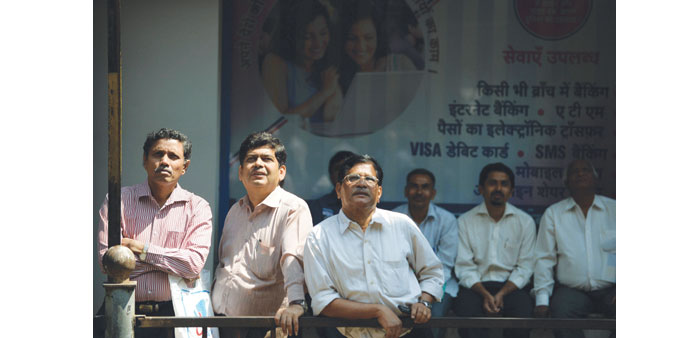
Indian bystanders watch share prices displayed on a digital broadcast on the
facade of the Bombay Stock Exchange building in Mumbai. The Sensex closed down 0.2% to 25,775.74 points yesterday after changing direction at least 20 times.
Bloomberg
Mumbai
Indian stocks dropped for a second day in a volatile trading session before the expiry of the monthly derivatives contracts and the start of the winter session of parliament on Thursday.
Hindustan Unilever, the biggest home-old products maker, and Housing Development Finance Corp, the largest mortgage lender, were the best performers on the S&P BSE Sensex. Maruti Suzuki India retreated the most in a week, while and Infosys, the second-largest software exporter, ended a three-day advance.
The Sensex lost 0.2% to 25,775.74 at the close in Mumbai, after changing direction at least 20 times.
The gauge has slid 3.3% this month after Prime Minister Narendra Modi’s Bharatiya Janata Party lost a state election, which raised concern about his ability to push through economic policies, including a goods-and-services tax bill. Lawmakers regroup for the winter session Thursday, the same day that the derivatives contracts lapse. Markets are closed Wednesday for a public holiday.
“The GST and the bankruptcy law bills are important,” said Vaibhav Sanghavi, managing director at Ambit Investment Advisors in Mumbai. “If these go through, it will be a good catalyst for the economy and the markets.” Sanghavi said he is bullish on auto and paint makers, and financials and industrial companies.
The government has proposed a set of bankruptcy rules, scrapping laws that date back a century, to help cut the time it takes to wind up a dying company and reclaim dues.
Hindustan Unilever surged 2.6% to its highest since October 28. Housing Development Finance climbed 2.3% to its highest since November 4. Maruti Suzuki tumbled 2%, paring this year’s rally to 39%. That’s still the best performance among the 30 Sensex companies. Infosys lost 1.2%, ending a three-day, 3.3% climb.
International investors were net sellers of Indian stocks for an ninth straight day on November 23, the longest series of outflows since September. They’ve sold $672mn of shares this month, the most among eight Asian countries tracked by Bloomberg, after South Korea.
“The volatility in currencies and commodities is impacting risk-money,” leading to outflows, Sanghavi said. The price swings will “give investors better entry points” to add to their equity holdings, he said.
The Sensex has fallen 6.3% this year and trades at 15.2 times projected 12-month earnings. The MSCI Emerging Markets Index is valued at a multiple of 11.2.
Meanwhile the rupee gained 0.2% to 66.3250 a dollar, prices from local banks compiled by Bloomberg show. That pared its November drop to 1.6%.
India’s 10-year sovereign bonds advanced for the first time in three days as a rise in yields to a two-week high lured buyers.
The yield on the notes due May 2025 fell to 7.70% in Mumbai from Monday’s 7.72%, which was its highest close since November 9, according to prices from the central bank’s trading system. The yield climbed in the last two days amid concern a proposed increase in the salaries ofmns of Indian civil servants risks derailing the government’s budget deficit goal. Local markets will be shut Wednesday for a public holiday.
“Value buying by some investors after the recent losses led to an advance in bonds,” said Soumyajit Niyogi, an interest-rate strategist at SBI DFHI Ltd in Mumbai. Debt markets will remain volatile given concerns over fiscal consolidation and a potential increase in US interest rates.
Ten-year yields have risen six basis points in November as foreign holdings of rupee-denominated debt dropped by Rs36.3bn ($547mn) in the biggest outflow since May, according to data compiled by Bloomberg. A government-appointed panel on November 19 recommended a 23.55% overall rise in salaries, a move that Finance Minister Arun Jaitley estimates will cost the exchequer Rs1.02tn in the year starting April 1.
The administration aims to lower the budget gap to 3% of gross domestic product in the year to March 2018 from 4.1% in the 12 months ended this March. The increase in salaries, along with higher economic stimulus spending, would make it harder to meet fiscal targets, Fitch Ratings said last week.
India’s finance ministry is seeking to set the small savings rates closer to government-bond yields, people familiar with the matter said, asking not to be identified as the plan under discussion isn’t public.