


AFP/Washington
 |
|
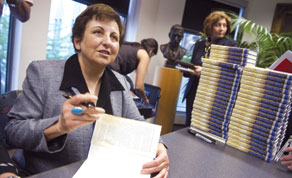
Shirin Ebadi signs her new book The Golden Cage: Three Brothers, Three Choices, One Destiny, about life in Iran, at the Carnegie Endowment for International Peace in Washington on Thursday |
“Democracy in Islamic and Arab countries, specifically Syria, will certainly affect democracy in Iran,” Ebadi told AFP on a visit to Washington. “If Syria becomes democratic, Iran will lose its puppet.”
Ebadi, a jurist and rights advocate who in 2003 became the first Muslim woman to win the Nobel Peace Prize, faulted Iran’s leaders for their focus on supporting Syria and other causes overseas.
“Muslims should help each other no matter where they are, but let’s not forget that in Iran some 20% of people live under the poverty line,” she said. “Shouldn’t the hungry people of Iran be fed first?”
“Although Senegal is an Islamic country, Iran sends arms to Senegal in order to help the opposition and create a civil war, meaning Muslims killing Muslims,” she said. “What does Senegal matter to Iran?”
A long-simmering insurgency in Senegal’s southwestern Casamance province has flared up this year due to what the Dakar government said was an Iranian arms shipment to the rebels. Iran denied the charge.
“Besides, why is it that when China kills Muslims, the government of Iran is silent?” Ebadi said, referring the restive Xinjiang region. “And why is it that when the Muslims of Chechnya are killed, the government of Iran is silent?”
Ebadi has not returned to Iran since its 2009 presidential election, whose disputed result set off widespread demonstrations against the clerical regime and clashes that killed dozens of protesters.
She voiced confidence that she would eventually return home and that Iranians would again rise up for change, saying: “Iran is like fire under the ashes.”
Ebadi expected any future protests to be peaceful, saying that Iran was tired of violence after the 1979 Islamic revolution, the bloody eight-year war with Iraq and persistent political strife.
“This is too much for one generation. Therefore the Iranian people’s behaviour is very peaceful and they’re not going to resort to violence. Unfortunately the government has been exploiting this peacefulness,” she said.
Ebadi delves into the Iranian psyche in a new book, The Golden Cage, which was published by Kales Press, an affiliate of W W Norton.
Better known for legal work and political statements, Ebadi turned to a novelistic style in the book as she related the modern history of Iran through three brothers pulled in separate paths.
One brother becomes a military officer who reveres the pro-Western shah, another shows a rebellious streak and joins the communist underground, while a third becomes an Islamist.
Ebadi, who said she knew the brothers first-hand but changed names, portrayed one character as wiser—the duelling brothers’ sister, Pari.
“Pari is a symbol of the Iranian woman’s character,” she said, predicting that women would play an outsized role in the country’s political development.
Ebadi also narrated in the book her own experience after falling afoul of authorities, describing the “white torture” of imprisonment in a filthy, solitary cell with no knowledge of time or hint of privacy.
More recently, members of the clerical regime have attacked Ebadi for her defence of seven leaders of the Bahai faith who were each sentenced to 20 years in prison on allegations including spying for foreigners.
In the interview, Ebadi vowed she would not back down.
“I have read all the files and there is no evidence of the accusations. So why should I not continue to defend them?” she said.