


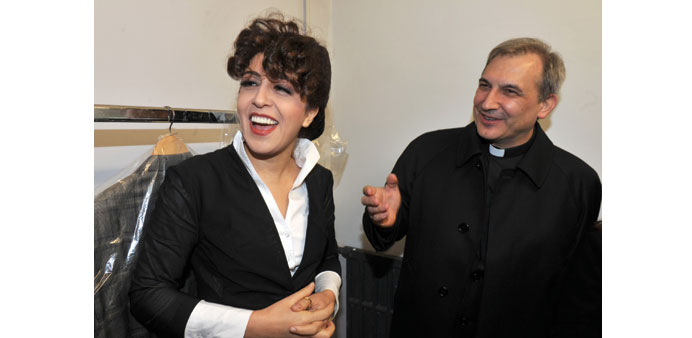
In this photo taken on January 15, 2014 at the Parioli theatre, Monsignor Vallejo Balda is seen with Chaouqui.
Reuters/AFP/DPA
Rome
The Vatican has ordered five people, including two Italian journalists, to stand trial for leaking and publishing secret documents, in the latest development in a leaks scandal which is rocking the papacy.
The trial stems from the publication of two recent books which depict a Vatican plagued by mismanagement, greed and corruption and where Pope Francis faces stiff resistance from the old guard to his reform agenda.
The Holy See was embarrassed and angered by the books, which it said used information that should never have been allowed to leave the walls of the city state.
Prosecutors said that three Vatican officials, including a high-ranking priest, formed “an organised criminal association” with the aim of “divulging information and documents concerning the fundamental interests of the Holy See and the State”.
The first hearing in the trial will begin on Tuesday at 0930 GMT, the president of the Vatican court ordered.
The leaks are one of the biggest internal scandals to hit the papacy of Pope Francis and are reminiscent of the “Vatileaks” furore that preceded the resignation of former pope Benedict XVI in 2013.
The Italian media has dubbed the latest episodes “VatiLeaks II”.
Two of the officials indicted, Spanish Monsignor Angel Lucio Vallejo Balda, who was number two at the Vatican’s Prefecture for Economic Affairs, and Italian laywoman Francesca Chaouqui, a public relations expert, were arrested earlier this month.
Both were members of a commission Francis set up in 2013 to study economic and administrative reforms.
The third official, Nicola Maio, was an assistant to Vallejo Balda.
The two journalists, Gianluigi Nuzzi and Emiliano Fittipaldi, wrote books based on the leaks.
They both “solicited and applied pressure, especially on Vallejo Balda, to obtain secret documents and information”, the court order said.
The books, Merchants in the Temple by Nuzzi and Avarice by Fittipaldi, were published this month.
The Vatican has said the books give a “partial and tendentious” version of events and has condemned the writers for trying to reap financial advantages from receiving stolen documents.
Both authors have rejected the accusations, saying they were just doing their jobs.
Nuzzi told Reuters yesterday that he had “never applied pressure on anyone” and would discuss with his lawyers whether or not to attend Tuesday’s hearing.
He said his lawyers had told him he risked 4-8 years’ imprisonment.
“The Italian constitution guarantees the right to information and expression but the Vatican is a state with no right to information,” he said. “If they think they can silence me they are following the wrong path, because after me other reporters will tell the facts and the information will not stop.”
It will be the first time in the history of the Vatican that a journalist is going before the Pope’s magistrates.
Fittipaldi told Italian media he was stunned by the Vatican’s move.
“Maybe I’m naive but I believed they would investigate those I denounced for criminal activity, not the person that revealed the crimes,” he said. “I understand they are seriously embarrassed in the Vatican over the things in my book, especially because they could not deny any of it. But I didn’t expect a criminal trial.”
Chaouqui was released shortly after her arrest, pledging to co-operate, but Vallejo Balda is still in a Vatican cell.
The scandal has revived painful memories of the last time employees aired the centuries-old institution’s dirty laundry.
In 2012, Benedict XVI’s butler engineered a series of leaks that revealed fierce infighting in the highest echelons of the Catholic Church and allegations of serious fraud in the running of the city state.
He was sentenced to 18 months in prison, before being pardoned by the pope but banished from the Vatican forever.
Nuzzi played a central role in breaking that story, which is widely believed to have contributed to Benedict’s shock decision to retire the following year.
The Vatican is a sovereign state with its own judicial system.
Should the accused not appear in court, the trial would go ahead in their absence, the Vatican said.
Fittipaldi had given a statement to the police earlier this week, while Nuzzi ignored a summons, citing significant shortcomings in the Vatican’s legislation on press freedom.