Agencies/Sanaa
At least seven people were killed including four policemen who clashed with a dissident army unit, as hundreds of thousands of anti-regime protesters rallied across Yemen yesterday.

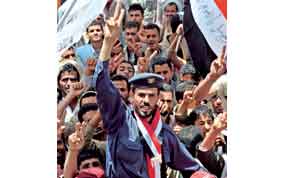
A soldier joins anti-government protesters during a demonstration in Sanaa yesterday
“Police attacked an army checkpoint in Jawlat Amran,” a suburb in northern Sanaa, “killing one officer and wounding two soldiers,” a military official said.
The four policemen died as the security forces traded fire with automatic weapons and rocket-propelled grenades in the incident late on Tuesday, he said.
The targeted army unit operates under the commander of northwest Yemen’s military region, General Ali Mohsen, who has sided with the protesters and accused regime supporters of trying to assassinate him, the official said.
An interior ministry statement accused Mohsen’s forces of starting the violence and said that police had no rocket-propelled grenade launchers in their possession.
Tens of thousands of demonstrators turned out in the capital after the clashes despite driving rain, saying they remained committed to the president’s removal.
“What worries us is that a war will break out between the army forces supporting the revolution and those who support the president staying. At that point the revolution will end and Yemen could turn into another Somalia just as Ali Saleh wants,” protester Ali Ahmed said in Sanaa.
In the south of the country, soldiers yesterday shot dead two anti-regime protesters and wounded nine others in different sectors of the port city of Aden, medics and witnesses said.
They said the army opened fire as protesters tried to set up roadblocks to enforce a partial general strike, which demonstrators have vowed to stage in Aden every Saturday and Wednesday until President Ali Abdullah Saleh’s fall.
They were the first deaths for exactly a month in the city, the site of deadly protests between late February and early March.
Aden’s security chief General Ghazi Ahmed Ali said: “Armed groups from the Common Forum (an alliance of parliamentary groups) and the (secessionist) Southern Movement blocked the roads and tried to break into police stations.”
Five civilians and four policemen were wounded in an attack on a station in the district of Al Mansura, he said.
Protests swept provinces across Yemen yesterday in response to calls by the Youth for Change, a coalition of groups that has led anti-Saleh demonstrations since late January.
The largest rally was being held in the flashpoint city of Taez, south of Sanaa, where more than 20 people were killed in clashes with security forces earlier this month.
Saleh loyalists also took to the streets, but in smaller numbers, in several provinces and chanted their support for the embattled leader.
Yemen’s Arab neighbours in the Gulf have urged Saleh, in power since 1978, to ensure a peaceful transition of power to Vice President Abd-Rabbu Mansour Hadi and a national unity government led by the opposition.
But protesters have rejected the proposal, demanding the fall of Saleh’s entire regime and for the Yemeni strongman to stand trial rather than be granted immunity along with his powerful sons.
Saleh, for his part, has accepted in principle the initiative of the Gulf Co-operation Council but without spelling out clearly whether or when he would step down.
He has so far insisted on overseeing any transition, fearful of being dumped out of office and faced with prosecution like his ally, Egypt’s president Hosni Mubarak, who was ousted on February 11 following mass demonstrations.
Opposition groups in parliament have remained reserved, apparently fearful of the reaction of protesters on the streets whose ranks have suffered more than 125 deaths in clashes with Saleh’s security forces.
Yemen’s Western allies and neighbouring Saudi Arabia fear that chaos in Yemen, where Saleh has already lost control of some provinces, could benefit an Al Qaeda arm that has used the country as a base to launch attacks on Saudi and US territory.
But nearby countries became convinced that Saleh is an obstacle to stability in a country that overlooks a shipping lane used to transport over 3mn barrels of oil a day.
Even before the start of the protests, Saleh was struggling to quell a separatist rebellion in the south and cement a truce with Shia rebels in the north.