


 |
|
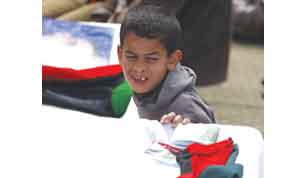
A boy touches the coffin of a man killed in Thursday’s accidental Nato bombing of rebel vehicles on the road between Ajdabiyah and Brega, during a funeral service in Benghazi yesterday |
Nato leaders acknowledged the limits of their air power, which has caused rather than broken a military stalemate, and analysts predicted a long-drawn out conflict that could end in the partition of the North African oil producer.
Alliance officials expressed frustration that Gaddafi’s tactics of sheltering his armour in civilian areas had reduced the impact of air supremacy and apologised for a “friendly fire” incident on Thursday that rebels said killed five fighters.
Misrata, a lone major rebel outpost in the west of the country, has been under siege by Gaddafi’s forces for weeks. Yesterday insurgents said they had pushed back an assault on the eastern flank of the coastal city after fierce street battles.
“The attack from the east has been repelled now and the (pro-Gaddafi) forces have been pushed back,” rebel spokesman Hassan al-Misrati said by telephone.
The only active front in the war, along the Mediterranean coast around the eastern towns of Brega and Ajdabiyah, has descended into a desultory stalemate with both sides making advances and then retreating behind secure lines.
Yesterday rebels at the western boundary of Ajdabiyah, still jittery after the friendly fire accident, fled from an artillery bombardment but there was no sign of a government advance.
Ahmed Ignashy, a doctor at Ajdabiyah hospital, said about six rebels were wounded in skirmishes 20km west.
The head of US Africa Command, General Carter Ham, said the conflict was entering stalemate and it was very unlikely the rebels would be able to fight their way into Tripoli.
Early hopes that air attacks on Gaddafi forces would tip the balance in favour of the rebels have now evaporated and Western leaders are emphasising a political solution.
Nato Secretary General Anders Fogh Rasmussen took a similar line to Ham yesterday. “There is no military solution only. We need a political solution,” he told Al Jazeera television.
Nato spokeswoman Oana Lungescu spoke of the difficulties facing alliance pilots because of Gaddafi’s tactics. “The fact is they are using human shields and parking tanks next to mosques and schools so it is very hard to pinpoint any military hardware without causing civilian casualties,” she said.
Analysts predicted an extended conflict leading towards possible division of the country between east and west.
“The opposition forces are insufficient to break this deadlock and so as things stand the march on Tripoli is not going to happen,” said John Marks, chairman of Britain’s Cross Border Information consultancy.
“This standoff looks like it could go on pretty much forever ... for now we have a stalemate so we are looking rather more at a de facto partition.”
Geoff Porter of North Africa Risk Consulting agreed. “It is increasingly unlikely that the rebels will get anywhere close to Tripoli,” he said.
Misrata, Libya’s third city, rose up with other towns against Gaddafi in mid-February and has been under siege for weeks after a crackdown put an end to most protests in the west.
Rebels say people in Misrata are crammed five families to a house in the few safe districts, to escape weeks of sniper, mortar and rocket fire. There are severe shortages of food, water and medical supplies and hospitals are overflowing.
Ashour Shamis, a UK-based Libyan opposition activist, said the coastal town was key to breaking the stalemate.
“The reason is that Misrata has a big port that acts as a key supply route of food and medicine for Tripoli, and Sirte as well. To keep Tripoli going, Gaddafi needs Misrata.”
The US yesterday extended financial sanctions to Libya’s prime minister and four other senior officials to increase pressure on Gaddafi’s circle.