


Paul Wilson, The Guardian/Manchester
David Beckham, you may have heard, is back at Old Trafford on Saturday afternoon, appearing in a Unicef charity match he helped to organise. Naturally all tickets have been sold, even though you could not have told Aston Villa or Manchester United fans from recent seasons that late-edition Robert Pires or Michael Owen were a treat to watch, but Beckham is good at this sort of thing.
Beckham, it must be admitted, is pretty good at most things. He might even be better in his present role as charity ambassador, clotheshorse, globetrotter and all-round good egg than he ever was at football but in all probability not. Even at this short distance from his retirement two years ago there is a danger of forgetting just how good Beckham was at football.
Strip away all the distractions, of which there were many, and the petty envy and mistrust, of which there was a surprising amount, and you are unquestionably left with one of the greatest of English post-war careers. Granted, Beckham did not win a World Cup, did not even come particularly close, and to that extent his place in the England and Old Trafford pantheon will always be secondary to Sir Bobby Charlton and others.
Yet if it is the misfortune of present generations of English footballers to be constantly and thanklessly compared to the Boys of ’66, Beckham has done more than most to compile an overall list of achievements worth weighing in the balance. He overtook Charlton’s England appearance record, for a start, and with 115 games for his country remains the nation’s most capped outfield player. Charlton won three league titles with United; Beckham managed five, then took himself off to play with distinction for Real Madrid and win the Spanish league in his final season.
Those are just the bare bones of the story. Not only is it difficult comparing players of wildly different generations and backgrounds, the distinction between a one-club player and someone who tested himself in more than a single country and culture is an added complication. As is the undeniable fact that Beckham played in a more consistently successful United side than even some of his most illustrious predecessors. Does that make his achievements greater or smaller?
If, as seems inevitable, Old Trafford orders a Class of ’92 statue at some point to stand alongside the famous trio of Best, Law and Charlton, the statistical comparison would be interesting, to say the least. The present statue, honouring the three household names from United’s 60s rise to become the first English winners of the European Cup (even if they did end up falling out with each other) boasts a total of seven league titles between the threesome.
Beckham has five on his own, plus one in Spain, and the Champions League medal collected as part of the 1999 treble. Gary Neville has two Champions League medals and eight English league titles. Paul Scholes can raise that by three more league titles, Ryan Giggs can go two further still. Were United to build a statue to Giggs, Scholes, Neville and Roy Keane, they would be honouring a quartet with a preposterous 39 league titles between them, not to mention FA Cups and European prizes. But while that foursome might be United’s most decorated, the plinth would not be complete without the presence of Beckham, arguably the most famous of the lot, and certainly the face of the Class of ’92 when they were still making their names on the pitch and proving Alan Hansen wrong about not being able to win anything with kids.
Sir Alex Ferguson had other leaders available as captains of Manchester United, but saw the same professional qualities as Sven-Goran Eriksson in Beckham. “He was extraordinary,” the former United manager says in his latest book. “When he first came to us he would train morning and afternoon then show up in the evening to join in with the schoolboys. At the start of each season we used to give all the players a bleep test to get a sense of their aerobic fitness, and Beckham was always off the scale. Cristiano Ronaldo was the same. He had this desire to become the greatest player in the world and was determined to do so. True winners are relentless. The very best players compete against themselves to become as good as they can be. They have to be dragged off the training ground.”
So how does the legend want to be remembered? Beckham does not mind if posterity judges him solely on perspiration. “I hope people remember me as a hardworking footballer,” he said recently. “Someone who gave everything he had every time he stepped on to the pitch.”
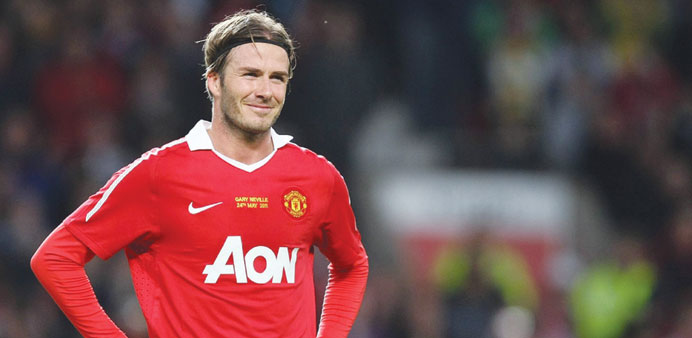
File picture of David Beckham during his United days.