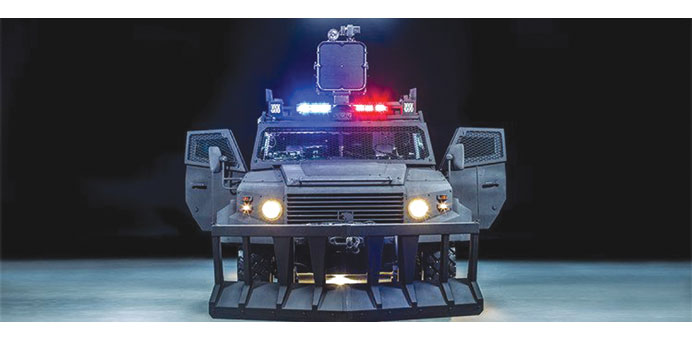
Nimr’s UAE-made Ajban ISV (Internal Security Vehicle), capable of “dispersing potentially violent crowd gatherings,” was the company’s flagship product at last week’s defence exhibition in Bangkok.
By Arno Maierbrugger
Gulf Times Correspondent
Bangkok
At the busy international Defence & Security 2015 exhibition held last week in Bangkok, one company from the UAE attracted considerable attention: Nimr Automotive, an Abu Dhabi-based manufacturer of wheeled military vehicles.
Nimr (Arabic for “tiger”), showcasing its 4x4 combat vehicles, said at the regionally important show that it has plans to expand in Asia for the first time in a “new phase in the company’s growth and development plans.”
“Nimr’s expansion of our sales footprint into Asia is a new exciting chapter in our history,” said Dr Fahad Saif Harhara, CEO of Nimr, “adding that “our modular vehicles are perfectly suited to the challenging terrain and environment in the region and will provide armed forces across the region with a leading-edge in capabilities to handle a wide range of mission requirements.”
Nimr currently produces three types of vehicles derived from a basic version which was co-developed with Russian engineers back in 2005. The vehicles are the 4x4 Ajban class, which the manufacturer describes as a multipurpose military vehicle, the 6x6 Hafeet class, a heavy-duty logistics vehicle, and the cross-over, customizable N35 class that can be deployed in different situational scenarios, including as armament carriers, logistics vehicles, ambulances or as mobile command and control centres. The vehicles are currently in operation in the armies of the UAE, Egypt, Jordan, Lebanon, Algeria, Libya and Tunisia.
At its Bangkok debut, Nimr came up with two vehicles, the basic Ajban 440, and the awe-inspiring Ajban ISV, or Internal Security Vehicle, capable of carrying up to ten crew and “equipped to deal with any internal security situation utilising audible and optical deterrents, as well as integrated situational awareness and communication systems for inter-vehicle coordination.”
“This vehicle is designed for dispersing potentially violent crowd gatherings,” a Nimr representative said at the defence show, which saw a sizable number of Thai military brass visiting, including Deputy Prime Minister and Thai Defence Minister, General Prawit Wongsuwon.
Nimr Automotive is a subsidiary of Emirates Defence Industries Company (EDIC), the UAE’s integrated defence manufacturing and services unit, of which Abu Dhabi’s investment holding Mubadala Development Company holds a 60% stake.
Originally, the development of Nimr vehicles was undertaken by Abu Dhabi-based Emirates Defence Technology, a privately held, Emirati-owned defence contractor and manufacturer. Detailed engineering and prototype of the first vehicle was completed by engineers from Industrial Computer Technologies, a subsidiary of Russia’s GAZ (Gorkovsky Avtomobilny Zavod), a large vehicle manufacturer dating back to the times of the Soviet Union. Further development of Nimr vehicles was carried out by Bin Jabr Group, a family business conglomerate in Abu Dhabi, until Nimr was brought under the wings of EDIC.
For Nimr, the expansion into Southeast and East Asia could prove favourable. Military spending throughout the region is growing at a faster pace than ever, and the Philippines, Vietnam, Indonesia, Malaysia, Thailand and Taiwan are all beefing up their military in the face of increasingly bold incursions in the region by China, which, in turn, unveiled its 2015 military budget of $145bn earlier this year, a 10.1% growth over 2014.
As for Thailand, the defence budget has nearly tripled from $2.2bn in 2005 to $5.75bn assigned for next year.