Reuters/Ajdabiyah, Libya
Libyan rebels fled in headlong retreat from the superior arms and tactics of Muammar Gaddafi’s troops yesterday, exposing the insurgents’ weakness without Western air strikes to tip the scales in their favour.

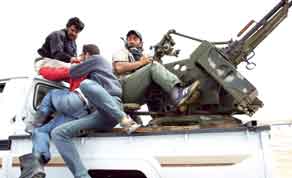
Rebel fighters and others cling onto the back of a pick-up truck with a mounted anti-aircraft gun as they flee artillery fire on the road between Ajdabiyah and Brega in Libya yesterday
It had taken more than five days of allied bombardment to destroy government tanks and artillery in the strategic town of Ajdabiyah before rebels rushed in and chased Gaddafi’s troops 300km west in a two-day dash along the coast.
Two days later the rebels have been pushed back to close to where they started.
The Libyan army first ambushed the chaotic caravan of volunteers, supporters and bystanders outside Gaddafi’s hometown of Sirte, then outflanked them through the desert, a manoeuvre requiring the sort of discipline the rag-tag rebels lack.
The towns of Nawfaliyah, Bin Jawad and Ras Lanuf fell in quick succession to the lightning government counter-strike.
Rebel spokesman Colonel Ahmed Bani said fighting was going on at Brega, the next town east along the narrow coastal strip that has been the theatre of most of the fighting. But many rebels had pulled back further to the strategic town of Ajdabiyah and regrouped.
“We thought it better to make a tactical withdrawal until we can think of better tactics and a strategy to face this force,” said Bani, adding: “One of the defence points will be Ajdabiyah, not the only one.”
He appealed for more allied air strikes and heavier weapons. “We are seeking weapons that will be able to destroy the heavy weapons they are using against us such as tanks and artillery.”
Dozens of rebel pick-up trucks mounted with machineguns milled around the western gate of Ajdabiyah. Confusion reigned.
Asked what was happening, one rebel said: “We don’t know. They say there may be a group of Gaddafi’s men coming from the south.” That would suggest another big flanking move through the endless desert which pins the coast road to the sea.
Cars carrying families and their belongings streamed out of Ajdabiyah towards the rebel stronghold of Benghazi.
Libya’s state news agency said thousands of Libyans carrying olive branches had joined a peace march towards Benghazi.
In town after town, Gaddafi forces have unleashed a fierce bombardment from tanks, artillery and truck-launched Grad rockets which has usually forced rebels to swiftly flee.
“These are our weapons,” said rebel fighter Mohamed, pointing to his assault rifle. “We can’t fight Grads with them,” he said earlier before joining the rush away from the front.
Without Western air strikes, the rebels seem unable to make advances or even hold their positions against Gaddafi’s armour. Warplanes flew over the battlefield for a time yesterday, but there was no evidence of any bombardment of government forces.
Rebel forces lack training, discipline and leadership. There are many different groups of volunteers and decisions are often made only after heated arguments.
When they advance it is often without proper reconnaissance or protection for their flanks. Their courage and enthusiasm notwithstanding, the insurgents tend to flee in disarray whenever Gaddafi forces start sustained firing.
“Whether we advance 50km, or retreat 50km ... it’s a big country. They will go back the next day,” rebel spokesman Mustafa Gheriani told reporters in the opposition stronghold of Benghazi.
“This revolution really is only five weeks old. On the political front it is very organised,” he said. “Normally it takes six months to train a soldier ... We are talking about citizens who picked up guns to protect their homes.”
A conference of 40 governments and international bodies agreed on Tuesday to press on with a Nato-led aerial bombardment of Libyan forces until Gaddafi complied with a UN resolution to end violence against civilians.
The Pentagon said on Tuesday 115 strike sorties had been flown against Gaddafi’s forces in the previous 24 hours, and 22 Tomahawk cruise missiles had been fired. Britain said two of its Tornado jets had attacked a government armoured vehicle and two artillery pieces outside the besieged western city of Misrata.
Libya’s official Jana news agency said air strikes by forces of “the crusader colonial aggression” hit residential areas in the town of Garyan, about 100km south of Tripoli, on Tuesday. It said several civilian buildings were destroyed and some people wounded.
UN Security Council Resolution 1973 sanctions air power to protect Libyan civilians, not to provide close air support to rebel forces. That would also require troops on the ground to guide in the bombs. Without forward air controllers, intervening from the air in such a fluid battle space is fraught with risks.
Air strikes then may not be enough to stop the Libyan desert civil war turning into a stalemate.
Russian Foreign Minister Sergei Lavrov said it was obvious Libya was “ripe for reforms”, but Libyans themselves must decide without influence from outside.