Agencies/Sanaa
Yemeni President Ali Abdullah Saleh, given a new lease of life by a solidarity rally as well as US fears over Al Qaeda and 150 deaths in a killer blast, has taken the initiative against calls for his ouster.

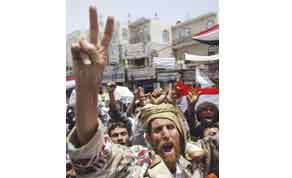
Protesters shout slogans during a rally to demand the ouster of Yemen’s President Ali Abdullah Saleh outside Sanaa University yesterday
Scoffing at pressure to quit at a time of growing insecurity, as highlighted by the blast at an ammunitions plant in southern Yemen, Saleh challenged his opponents to leave the country instead, in remarks published yesterday.
“I tell those who appear in the media asking others to leave, that it is up to them to go,” said the embattled president, quoted on state news agency Saba, branding his rivals as nothing more than “paid agents and collaborators”.
The veteran leader, in power for 32 years, accused the parliamentary opposition of wanting to “seize power through the blood of youths”.
Protests against Saleh intensified after a March 18 bloodbath when regime loyalists gunned down 52 people outside Sanaa University, sparking widespread international condemnation and a string of anti-regime defections.
While a massive crowd protested against Saleh’s regime in Sanaa last Friday, the 69-year-old president’s loyalists staged a huge counter-demonstration of his supporters.
Saleh on Monday accused “Al Qaeda, the Houthis (Shia Zaidi rebels of north Yemen), separatists” in the south and the parliamentary opposition of ganging up against his regime at the expense of Yemeni stability and security.
A declared ally in the US battle against Islamist militants, Saleh is grappling with anti-regime protests which have divided the army, a secessionist movement in southern Yemen, and a resurgent Al Qaeda.
His remarks came after Washington warned on Sunday that the fall of Saleh would pose a “real problem” for the US.
“I think it is a real concern because the most active and at this point perhaps the most aggressive branch of Al Qaeda, Al Qaeda in the Arabian Peninsula, operates out of Yemen,” said US Defence Secretary Robert Gates.
A top opposition figure in parliament, Mohamed Sabri, said: “The US defence minister’s exaggeration of Al Qaeda has encouraged the regime.”
But the US ambassador to Yemen, Gerald Feierstein, has held talks with two leading figures who have defected, sources close to both men said yesterday.
Feierstein met on Monday with General Ali Mohsen al-Ahmar, commander of the military’s northwest region which covers Sanaa, and Sadiq al-Ahmar, head of the Hashid tribal federation, the largest in deeply tribal Yemen.
Meanwhile, negotiations with the president on a transition have been suspended since last Thursday, according to Sabri. “Saleh is shirking his commitments, and negotiating with him is useless,” he said.
Saleh himself called for “those wanting power to head to the polls”.
Last week, he reportedly offered to step down by the end of 2011, a proposal snubbed by the opposition. But his ruling party said on Friday he should serve out his current term until the next scheduled presidential election in 2013.
With the political showdown in limbo and tensions running high across the impoverished country, the death toll of a massive blast and fire at an ammunition plant looted by Al Qaeda has shot up to 150, local officials said.
In Sanaa late on Monday, a son-in-law of the president, Yahya Mohamed Ismael, joined the protesters camped at the square near the university since February 21.
And a dozen army officers joined the protesters at the square at the same time.
Saleh has sacked and replaced the army commander for Yemen’s eastern region, General Mohamed Ali Mohsen, who has also joined the anti-regime camp, according to the defence ministry’s 26sep.net website.
l Yemenis worried the political crisis will deteriorate have begun hoarding basic foods like wheat and sugar, driving prices higher, the trade minister said.
Hisham Sharaf Abdalla said retail prices for wheat had risen by more than 15% in the past month, while other basic foods had gone up by 10 to 15%.
“It is because of the political atmosphere. People buy anything for any price if they know that thing will vanish... So they keep these things in their houses,” Abdalla said in an interview late on Monday.
“They are afraid if civil war or clashes happen that all shops will be closed. And then the merchants themselves will put the price up, even 50% up...They are telling you maybe nothing will be imported. This is what is in their minds.”