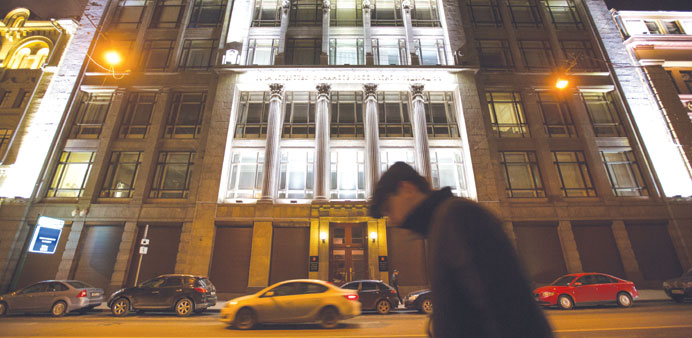
A pedestrian passes the headquarters of Russia’s ministry of finance in Moscow. The economy is in a deeper hole because commodities remain mired in the worst slump in a generation and the nosedive in consumer spending shows little sign of easing.
Bloomberg
New York
Ending Russia’s recession may be the easy part.
What will come next is a prolonged period of muted growth after a sharp decline, putting the economy on an L-shaped trajectory, according to 21 of 31 analysts surveyed by Bloomberg. More than half say the recession hasn’t yet troughed and annual expansion won’t resume until the third quarter of next year or later.
Muddling through would mark a departure for Russia, whose recessions in 1998 and 2009 set the stage for sharp rebounds as stronger oil prices and a surge in domestic demand helped make up lost ground.
The economy is in a deeper hole this time because commodities remain mired in the worst slump in a generation and the nosedive in consumer spending shows little sign of easing.
“It is likely that the Russian economy bottomed out and is starting to recover,” Sergey Narkevich, an analyst at PAO Promsvyazbank in Moscow, said by e-mail. “However, the path of this recovery is expected to be long and difficult.”
Top officials have remained upbeat. Economy Minister Alexei Ulyukayev sees a return of annual expansion in the second quarter of 2016, jumpstarting the economy to 0.7% growth next year after a 3.9% slump in 2015.
President Vladimir Putin said that the economy has found a “certain equilibrium” even as the task remains to restore positive economic growth, ensure a balanced budget system and keep pushing the inflation rate lower.
It’s the struggle to keep a lid on prices that’s sidelining central bank efforts to do more to shore up the economy. Monetary stimulus is ill-suited to revive growth as intensifying inflation risks and a bout of currency weakness forced the Russian central bank to extend an interest-rate pause last week, according to Governor Elvira Nabiullina.
Policy makers halted their easing cycle in September after six percentage points of interest-rate cuts this year brought their benchmark to 11%.
Annual inflation eased slightly to 15.6% in October from 15.7% a month earlier, the same drop as in September, according to the median of 20 estimates in a Bloomberg survey.
The Federal Statistics Service in Moscow will report the data this week.
“The state of the Russian economy is very bad and its improvement should not be expected in the coming months,” said Monika Kurtek, an economist at Bank Pocztowy in Warsaw. “In addition to political factors, also important for Russia is the price of oil on international markets, and there are indications that it will be sustained at the current low level for a long time.”
The government, which relies on oil and gas for almost half of its revenue, is drafting next year’s budget by assuming an average oil price of $50 a barrel, and crude may remain near that level for years, according to Ulyukayev.
Russia has adjusted to the collapse in oil prices by allowing the ruble to lose almost half its value since January 2014. The currency has stabilised in recent weeks, gaining 2.3% against the dollar in the past month.
The central bank forecasts the economy won’t return to annual growth until 2017, meaning Russia is on track for the longest recession in two decades. Gross domestic product in the first nine months is down 3.8% from a year earlier, according to the Economy Ministry.
GDP will grow 0.2% in 2016 and 1.1% the following year, according to the median of analysts surveyed by Bloomberg.
Underlining the arduous road to recovery, services contracted in the beginning of the fourth quarter. The Purchasing Managers’ Index for the industry fell to 47.8 in October, the lowest in seven months, from 51.3 a month before, according to a statement released Thursday by Markit Economics. The gauge has been below the 50 threshold that separates contraction from growth for six months this year.
“The question is: Where growth should come from?” said Wolf-Fabian Hungerland, an economist at Berenberg Bank in Hamburg, Germany. “The last 18 months saw only little investment. This will leave only slowly-healing wounds - and even scars.”
Also weighing on the outlook is rouble volatility. While the currency’s swings have abated, its three-month implied volatility remains the highest globally, according to data compiled by Bloomberg.
The rouble’s fluctuations will intensify from November through December compared with recent levels, according to 77% of economists surveyed by Bloomberg.
“The rouble volatility will increase because of a need to weaken the rouble to support public finances,” said Per Hammarlund, the chief emerging-market strategist in Stockholm at SEB AB.