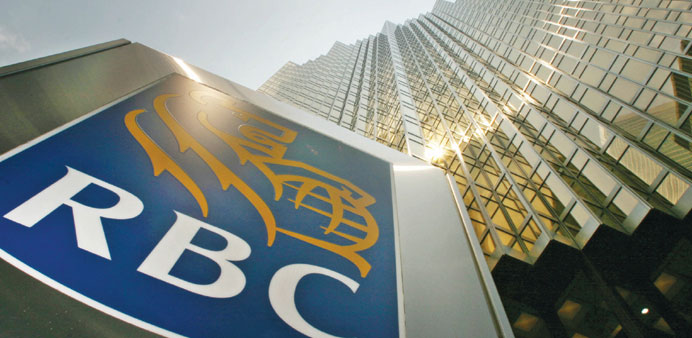
The Royal Bank of Canada headquarters in Toronto. RBC, the country’s second-largest lender by assets, will have the lowest capital strength among the biggest Canadian banks after it completes its takeover of Los Angeles-based City National.
Bloomberg
Toronto
Royal Bank of Canada’s $5.4bn purchase of City National Corp, its largest-ever takeover, is forecast to put the lender on the sidelines for acquisitions and share buybacks until it can rebuild capital to levels that satisfy regulators.
Royal Bank, the country’s second-largest lender by assets, will have the lowest capital strength among the biggest Canadian banks after it completes its takeover of Los Angeles-based City National, analysts including Scotia Capital’s Sumit Malhotra said. The Toronto-based lender could face further capital requirements if global regulators designate Royal Bank as systemically important last week.
Royal Bank said its common equity Tier 1 capital ratio could be about 9.5% after the scheduled close of the City National deal. Canada’s six-largest lenders averaged 10.2% as of July 31. Tier 1 capital consists of a bank’s common equity, including cash reserves, and qualifying preferred stock, all of which absorb losses when a bank is in financial stress.
“Following the close of City National, over the next number of quarters, we intend to accrete capital back up to approximately a 10% level,” Chief Financial Officer Janice Fukakusa said in an e-mailed statement. Royal Bank may look at buybacks or “selective acquisitions” after hitting that target, she said at a September 17 banking conference. “Buybacks and acquisitions would, in my view, be limited until Royal organically builds up its capital,” Malhotra said in a phone interview. “They would be somewhat hamstrung relative to peers in terms of capital deployment when the sector is already growth challenged.”
Canadian banks have earned international recognition for their capital strength and for sidestepping the financial crisis, with the World Economic Forum ranking them the world’s soundest for eight straight years. That’s partly due to Canada’s banking regulator, which pushed lenders to bolster capital buffers ahead of deadlines by international watchdog agencies.
Canada’s Office of the Superintendent of Financial Institutions told banks in March 2013 that they’re systemically important domestically and need to reserve an additional 1% of risk-weighted capital by 2016 to safeguard against failure. That added to OSFI’s requirement that lenders hold at least 7% core Tier 1 capital by January 2016.
“Whatever the official rules are, there seems to be a moving buffer in terms of what the actual level required is to actually be able to undertake capital deployment,” Malhotra said. “
Royal Bank also faces the prospect of being named a globally systemically important bank, or G-SIB, by the Financial Stability Board, which may require the lender to hold an additional 1% of capital or more above Basel levels. OSFI hasn’t said if such a designation would mean additional requirements above the Canadian regulator’s demands.
“If any Canadian banks were designated as a G-SIB at some point in the future, OSFI would communicate additional requirements, if any,” Annik Faucher, spokeswoman for the regulator, said in an e-mailed statement.
Royal Bank’s shares have fallen 7.2% this year, compared with the 5.7% decline of the eight-company Standard & Poor’s/TSX Commercial Banks Index.
Running too close to regulatory requirements - especially amid stock market volatility - prompted National Bank of Canada to sell C$300mn ($227mn) of shares last month to bolster its balance sheet. The Montreal-based lender’s stock dropped 5.3% the day after announcing the share sale. Canada’s sixth-largest lender said the sale would increase its regulatory capital ratio to 9.8% at the end of October.
Royal Bank will face pressure to boost its balance sheet since a 9.5% capital ratio over time will be viewed as low by creditors and regulators, said David Beattie, a senior vice president for Moody’s Investor Services.