


Reuters/
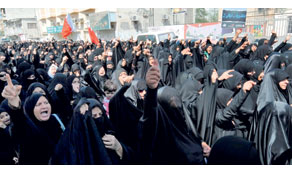
Bahraini female opposition protesters march during the funeral procession of killed protester Ahmed Abdullah in Daih village on the outskirts of Manama yesterday
Bahrain

The call came as a fourth protester died of wounds sustained when troops and police moved on Wednesday to end weeks of unrest that prompted the king to declare martial law and call in GCC troops.
US Secretary of State Hillary Clinton said
“We have made clear that security alone cannot resolve the challenges facing
The crackdown, in which troops and police fanned out across
Mourners at the funeral of one of the protesters killed in this week’s crackdown were defiant. Shaking their fists and chanting slogans, thousands gathered at the burial of computer technician Ahmed Abdullah Ahsan in the Shia suburb of Diah yesterday.
“I’m not angry. I’m proud of my son. He is a martyr,” his mother said.
Ahsan was buried in a plot near the first man killed in the uprising that began last month and whose grave was covered in flowers and photographs. As men lowered the body into the grave, the women, clad in black chadors broke off to hold a small protest at the side of the road.
Police and troops did not intervene despite a blanket ban on all public gatherings.
In an effort to bring life gradually back to normal, the authorities cut back by four hours yesterday a 12-hour curfew that had been imposed on large areas of the capital
The curfew now runs from
The government also urged public employees and both public and private schools and universities to return to work after days of closures and shortened hours. Some of the larger malls began to reopen yesterday, after days of closures and there were fewer checkpoints in the streets, though helicopters still buzzed over some areas.
“When people go back to work tomorrow, how will they face each other? How will they be able to look at each other in the office and pretend none of this happened?” said Ahmed, 50.
On Friday, diggers tore down the monument at the centre of
The unrest had brought
Most are campaigning for a constitutional monarchy, but there have been calls by hardliners for a change in the government.Yesterday, Shias in
Bahrain also imposed a night time curfew on fishing, swimming or using the coast.
Kuwait was also sending a medical team to Bahrain today, Bahrain News Agency said. The news comes as doctors complain that access to Salmaniya hospital has been held back by troops.
Doctors said two colleagues who had spoken out about the casualties received during weeks of unrest had been detained and human rights groups have called for all detained to be freed.