


 |
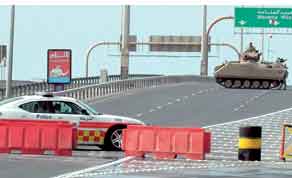
| A Bahrain police car and an army tank block a main intersection near the capital Manama yesterday |
Up to six people were killed in the violence which has fuelled regional confrontation.
US Secretary of State Hillary Clinton said in a television interview yesterday Bahrain and its allies who have sent troops to help it put down anti-government demonstrations are on the wrong track.
“We find what’s happening in Bahrain alarming. We think that there is no security answer to the aspirations and demands of the demonstrators,” Clinton told CBS in an interview.
A member of parliament from the largest Shia opposition group denounced the government assault as a declaration of war on the Shia community.
“This is war of annihilation. This does not happen even in wars and this is not acceptable,” Abdel Jalil Khalil, the head of Wefaq’s 18-member parliament bloc, said.
“I saw them fire live rounds, in front of my own eyes.”
A protest called by the youth movement, which had been leading protests at the Pearl roundabout, failed to materialise after the military banned all marches and gatherings and imposed a curfew from 4 pm to 4 am across a large swathe of Manama.
A witness saw Bahraini tanks move in the direction of Budaya Street, where the protest was set to take place.
Washington, a close ally of Bahrain and Saudi Arabia, has called for restraint in the island kingdom, home to the US Navy’s Fifth Fleet.
It sent US Assistant Secretary of State Jeff Feltman to Bahrain to push for talks to resolve the crisis.
Most Shias in Bahrain want a constitutional monarchy but calls by some hardliners for a change in the government have alarmed many.
Iranian President Mahmoud Ahmadinejad said Bahrain’s crackdown was “unjustifiable and irreparable”.
Helicopters flew overhead and riot police fired teargas as they advanced from about 7 am on the Pearl roundabout, focal point of weeks of protests. Youths hurled petrol bombs at police near the roundabout and scattered as new rounds of teargas hit.
The area was cleared within about two hours but protesters knocked down two police in their cars as they fled.
At Budaya health centre, a visitor saw about 50 casualties.
“I’ve seen some terrific wounds, lots of people hurt by bird shot. One had half his head injured with that. One had his hand blown up by some kind of bullet. He was using his other hand to show the victory sign,” he said, declining to give his name.
“There’s less than 50 injured there but it’s very small there’s not enough chairs even for everyone. I went to donate blood but they couldn’t even test it because of lack of equipment,” he added.
A medical source said dozens were taken to Bahrain International Hospital, hit by rubber bullets or shot gun pellets or suffering tear gas inhalation, all weapons used by riot police. One was hit by a live bullet.
Wearing semi-automatic rifles and black face masks, Bahraini troops blocked off several streets including the main road to the Shia area of Sitra. Tanks guarded key intersections and the entrances to some areas. Streets were deserted, shops were closed and people queued at cash machines.
“There are shots near and far. It’s not only shooting in the air, it’s urban warfare,” said a resident who lives near the Budaya Street, adding that forces had cut off some roads leading to Bahrain’s airport, on Muharraq island.
Riot police blocked access to Manama’s Salmaniya hospital, where many civilian casualties had previously been treated, and witnesses said access to other health centres was also blocked.
It did not appear that Gulf forces invited in by the government for support were involved in the operation.
“This was a major and a dangerous decision because this issue has been internationalised now. There are protests in Iraq, in Iran, in Lebanon,” said Wefaq MP Jasim Hussein.
“It has been internationalised and there was no reason when our demands were local demands,” he said.
Meanwhile, Bahrain’s health minister has resigned over the government’s crackdown on pro-democracy protesters and the housing minister is boycotting cabinet meetings, an opposition newspaper reported.
Al Wasat did not given a reason on its website why Nezar bin Sadeq al-Baharna, a Shia who was recently appointed health minister, had resigned but said he had witnessed people being mistreated in a wing of the Salmaniya hospital.
It said that Housing Minister Majeed bin Mohsen al-Alawi, another Shia, was “boycotting” government.
“I boycott the government because of the way it is dealing with the current events in the country,” the site quoted him as saying.
Twelve judges from the Shia court circuit also submitted their resignation in a statement sent to Al Wasat, citing the “bloody events, use of excessive force and weapons”.
Bahrain has been gripped by its worst unrest since the 1990s after protesters took to the streets last month, inspired by events in Egypt and Tunisia.
Swedish Foreign Minister Carl Bildt said on his blog that developments in Bahrain risked a regional conflagration.
“When the Gulf states now send military units to the small and prosperous island state, there is a very critical risk that the situation will instead be seen as part of a broader confrontation,” he said.
“While there was most likely initially no Iranian interference, the opportunities for Iran to take advantage of the situation now undeniably grow.”
The British embassy upgraded the travel warning on its website yesterday as the security situation deteriorated and residents trying to flee said flights out of Bahrain were full.
The UN and Britain have echoed the US call for restraint and the Group of Eight powers expressed concern.