


Reuters
London
Barclays said it will pay incoming chief executive James “Jes” Staley up to £8.24mn ($12.6mn) a year after appointing the former JPMorgan investment bank boss to one of the most prominent posts in British business.
Staley will join Barclays as CEO at the start of December, having been widely expected to be appointed after sources and other media reports this month said he had been chosen and just needed regulatory approval.
Boston, Massachusetts-born Staley, 58, faces a number of challenges at Barclays, including improving its reputation after a series of scandals, cutting costs to try and improve profitability, and deciding how big an investment bank it should keep in the wake of tougher regulations.
Staley said yesterday he planned to complete a restructuring of the investment bank and said Barclays must avoid an adversarial relationship with regulators.
“We will complete the necessary transformation and repositioning of the investment bank to a less capital-intensive model,” Staley said in a memo to staff.
Barclays Chairman John McFarlane said Staley had the appropriate leadership talent and wide-ranging experience to improve shareholder value and take the bank forward.
“In particular, he understands corporate and investment banking well, the re-positioning of which is one of our major priorities,” McFarlane said.
Investors and analysts have said Staley should improve morale and set a clear strategy for the investment bank after years of uncertainty, but they warned he should not build it back up aggressively.
“We had warmed to Barclays on the basis that it was de-emphasising the relatively low-return investment banking business ... and we would see a material reversal of this strategy as a negative to the investment case,” Shore Capital analyst Gary Greenwood said.
Staley’s appointment is the second time in recent years Barclays has named an American investment banker as CEO, the last being Bob Diamond who quit in 2012 over the Libor scandal.
Barclays shares were down 0.8% at 0740 GMT, in a broadly flat European bank sector. Barclays said Staley’s annual pay will consist of a salary of £1.2mn, a role-based “allowance” of £1.15mn in shares, a cash allowance of up to £400,000 and up to £5.5mn in annual bonus. He will be granted about £1.9mn of Barclays shares to compensate for an unvested share award granted by JPMorgan. He will also receive standard benefits including medical cover, life assurance and relocation costs.
The keen yachtsman previously ran JPMorgan’s investment bank and asset management business and had been at the US bank for 34 years before leaving in early 2013 to join US hedge fund firm BlueMountain Capital Management. He made the shortlist when Barclays last looked for a CEO three years ago.
Previous Barclays CEO Antony Jenkins was fired in July after losing the support of non-executive directors in a clash over style and the pace of the bank’s turnaround.
The bank is just over halfway through a three-year plan to cut 19,000 jobs, including 7,000 in the investment bank, still faces litigation issues and is trying to improve returns.
McFarlane said he knew Staley well and the pair were in agreement on the way forward, in particular the need to accelerate the delivery of improved shareholder returns. Staley understood the business and “also the importance of cultural reform and the need to conduct our business in a way that we can all be proud of,” McFarlane said.
Barclays has run into trouble with authorities and regulators over past conduct issues including alleged rigging of Libor benchmark rates and foreign exchange manipulation. Staley said his respect for the role of regulators was unequivocal.
“Core to that objective is having relationships with regulators that are collaborative, not adversarial,” Staley said in the memo. “We must therefore complete the cultural transformation of the group. There can be no retreat from becoming a values-driven organisation which conducts itself with integrity at all times.”
The memo said the bank had tremendous assets but needed to do more and generate better returns for shareholders. “They have been patient and now we must deliver for them.”
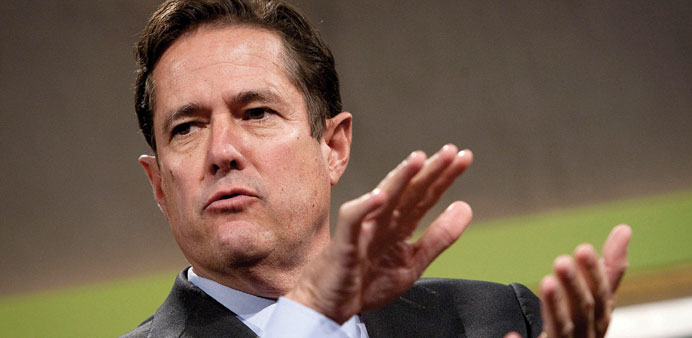
Staley: Facing challenges.