


 |
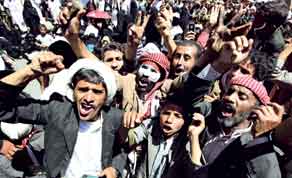
| Anti-government protesters shout slogans during a protest demanding the ouster of Yemen’s president outside Sanaa University yesterday |
Illustrating the potential for rifts among his diverse opponents, young activists who have taken the lead in ever-swelling street protests demanded immediate change in the country.
Protesters chanted slogans near Sanaa University, where once-small student-led protests have grown into daily rallies of 10,000 or more. “No negotiation and no dialogue until the regime leaves,” they chanted.
Elsewhere, 30 people were wounded as Saleh loyalists clashed with several thousand protesters in the Red Sea town of Hudeidah, southeast of the capital Sanaa. The opposition, which just two days ago had said it would not retreat from demands that Saleh leave power immediately, agreed with religious and tribal leaders to ask him to take steps towards a transition.
These included changing the constitution and rewriting election laws to ensure fair representation in parliament, open up voter registration and make politics more democratic overall. The opposition also wants the removal of Saleh’s relatives from leadership positions in the army and security forces, and a guaranteed right to peaceful protest.
Yemen, already plagued by regional separatism and Al Qaeda insurgents, has become one of the Arab nations most shaken by popular unrest sweeping across North Africa and the Middle East.
“What was presented (to a representative of Saleh) was a road map for departure within a time frame of a month or two, or six months,” said Mohamed al-Sabry, a spokesman for Yemen’s main opposition coalition which includes Islamists and leftists.
“As for the people’s demand for the departure of the regime, there is no going back on that,” he added. The rotating opposition chairman, Mohamed al-Mutawakil, said the coalition was also asking for trials of those responsible for a harsh crackdown on protests in which 24 people were killed in two weeks, most in the south.
Disturbances continued there yesterday as police and armed squatters clashed. Two people were killed.
“We have to start the transfer of power from the person to civil society organisations, and this is a needed step to ensure a safe and peaceful exit to the situation Yemen is living in,” he said, saying a transition should be completed this year.
There was no immediate response from the government.
Saleh, a key ally of Washington’s against Al Qaeda’s resurgent Yemen-based arm, has vowed to step aside when his term ends in 2013 and avoid transferring power to his son.
He has had trouble persuading opponents this would be anything more than a manoeuvre to ward off a spillover of unrest already raging in Libya, Bahrain and Oman..
Protesters on the streets -- 10,000 each in Sanaa and the industrial cities of Taiz and Ibb -- showed little readiness to allow a more measured transition, complicating efforts to give Saleh a respectable way out.