Reuters/Jerusalem
Israeli settlers damaged houses and cars in two Palestinian villages yesterday, witnesses said, in an apparent show of anger over Israel’s demolition of homes in an unauthorised settler outpost.

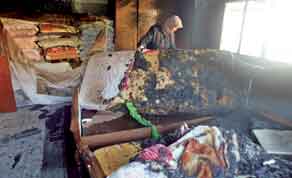
A Palestinian woman holds a burnt mattress as she surveys the damage caused by Jewish settlers who threw a petrol bomb into her house on Monday night in the West bank village of Hiwwara near Nablus
Villagers in Hiwwara in the occupied West Bank said settlers threw petrol bombs into a house, broke the windows of another, and burned several cars in the overnight rampage before moving on to nearby Burin, where Israeli soldiers prevented them from attacking a mosque.
There were no reports of injuries. An Israeli police spokesman said the incident was being investigated.
“We tried to put off the fire but we could not, because it was huge. The whole front room burned down and part of the sitting room,” said Rami Edmeidi, the owner of the home that came under attack in Hiwwara.
The violence followed the bulldozing on Monday by Israeli authorities of two homes at Havat Gilad, a hilltop West Bank settlement built without Israeli government permission.
Israel has long promised the US to dismantle outposts whose construction has not been sanctioned by Israeli authorities. But Israeli leaders have been reluctant to act in the face of opposition by settlers and their political backers.
The demolition at Havat Gilad followed Washington’s veto on February 18 of a draft UN Security Council that described all Israeli settlements as “illegal” and urged Israel to “immediately and completely” halt settlement activity.
In remarks to legislators from his right-wing Likud party on Monday, Prime Minister Benjamin Netanyahu - whose refusal to renew a halt to building in settlements led to the collapse of peace talks with the Palestinians - hinted he was limiting the scope of construction as a result of international pressure.
Netanyahu told the forum, according to a Likud spokesman, that while construction is under way in West Bank settlements, “in some places there are no (building) tenders”.
Israel faces “a very difficult international reality, and the US veto in the Security Council was achieved with great efforts”, he was quoted as saying.
Netanyahu also must contend with pro-settler sentiment within his party and governing coalition. Anger was high among settler activists in response to the use by police of plastic-coated paint bullets to quash resistance at Havat Gilad.
It was the first time the non-lethal weapon was used against settlers, eight of whom were arrested. “Bibi, at Havat Gilad, you shot yourself in the foot,” read posters, citing Netanyahu’s nickname, at bus stops outside West Bank settlements.
Likud legislator Danny Danon said he and other settler supporters in the party intend to rachet up pressure on Netanyahu to boost construction in settlements.
“We are not prepared to accept any discrimination between Jews living in the cities of Judea and Samaria (the West Bank) and the rest of the Jews in Israel,” Danon said.
Some 500,000 Israelis and 2.5mn Palestinians live in the West Bank and East Jerusalem, areas Israel captured from Jordan in the 1967 war.
Palestinians fear settlements, which the World Court has deemed illegal, will deny them a viable state. They say construction in settlements must stop before peace talks, frozen some three weeks after they began in September, can resume.
The US administration said its veto in the UN Security Council should not be misunderstood as support for the settlements but that it believed passage of the resolution would only harden Israeli and Palestinian positions.
Angry settlers said they are planning a ‘Day of Rage’ later this week over the police action.
It was not immediately clear what form the protest would take, but media reports suggested it would involve sit-down protests at major junctions across the country, as well as attempts to block Palestinian traffic in the West Bank.
Palestinians in the Nablus area said yesterday that there was a large number of Israel forces deployed around several villages in a bid to protect them from being attacked by settlers. Anti-settlement movement Peace Now says there are more than 100 wildcat outposts strewn across the West Bank, all of which have been set up without permission from Israeli authorities.