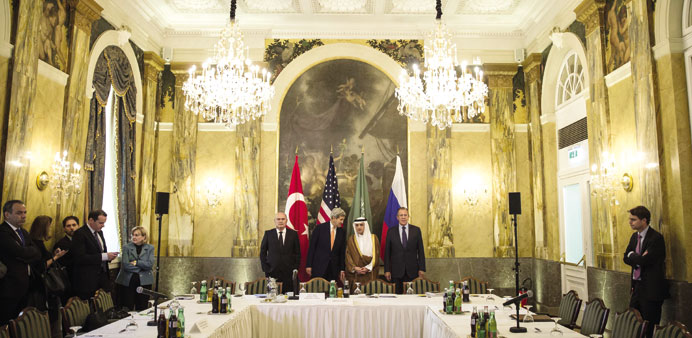
Turkish Foreign Minister Feridun Sinirlioglu, US Secretary of State John Kerry, Saudi Arabia’s Foreign Minister Adel al-Jubeir and Russia’s Foreign Minister Sergey Lavrov ahead of their meeting in Vienna yesterday.
Reuters/Vienna
US Secretary of State John Kerry said yesterday he expected new talks on Syria to begin as soon as next week, and did not rule out participation by Iran, President Bashar al-Assad’s closest ally.
Along with counterparts from Saudi Arabia and Turkey, Kerry met for two hours yesterday in Vienna with Sergei Lavrov, foreign minister of Russia, which has transformed momentum in the four-year-old Syrian civil war by bombing Assad’s enemies.
“What we agreed to do today is to consult with all parties and aim to reconvene, hopefully as early as next Friday, with a broader meeting in order to explore whether there is sufficient common ground to advance a meaningful political process,” Kerry told reporters.
“I am convinced ... that today’s meeting was constructive and productive and succeeded in surfacing some ideas, which I am not going to share today, but which I hope have a possibility of ultimately changing the dynamic.”
Asked if a meeting next week could include Iran, Kerry said he would not speculate on who might attend. But he added: “We want to be inclusive and err on the side of inclusivity rather than exclusivity.”
Iran has not been invited to previous international peace conferences on Syria, all of which ended in failure, while the war, which has so far killed more than 250,000 people and driven millions from their homes, has raged on.
Russia has long maintained that Iran should be included in Syrian peacemaking. Lavrov said he hoped Iran, as well as Egypt, would be invited to the next round of talks.
“We requested that future contacts take place in a more representative format,” he said in comments broadcast on Russian television.
Saudi Arabian Foreign Minister Adel al-Jubeir said that yesterday’s meeting had failed to achieve consensus over the future of President Assad. Kerry, too, acknowledged wide differences with Moscow and Tehran over the future of Assad.
“Diplomacy has a way of working through very difficult issues that seem to be absolutely contradictory and, on their face, begin at odds. And this is one of those issues where the statements clearly - and current positions - are at odds,” Kerry said. “But if we can get into a political process, then sometimes these things have a way of resolving themselves.”
Russia’s decision to enter the conflict with air strikes has upended the strategy of the US and its regional and European allies.
Washington is leading its own bombing campaign against Islamic State fighters who control swathes of eastern Syria and northern Iraq, so the Russian intervention means the Cold War-era superpower foes are now flying combat missions in the same air space for the first time since World War Two.
Washington and Moscow both say they are targeting Islamic State, but they have opposing visions of Syria’s future, with Washington saying Assad must leave power to bring peace and Russia describing his government as a bulwark against militants.
Russia describes all its bombing targets as belonging to Islamic State. The US and its allies say the overwhelming majority of Russian strikes have targeted other groups opposed to Assad, including groups they have backed.
Lavrov also said yesterday that Russia had agreed to co-ordinate its military action on Syria with Jordan, another important regional ally of the US, by setting up a “special working mechanism” in the Jordanian capital, Amman.
Kerry said he welcomed any such co-operation, if it would help fight Islamic State. “We have no problem whatsoever with this effort and it may even help make certain that the targets are the targets that they ought to be.”