


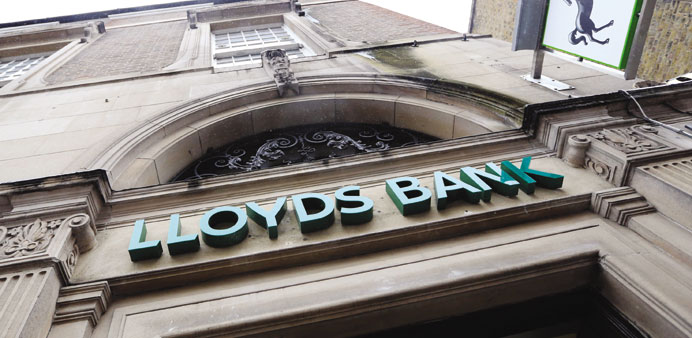
A logo is seen above the entrance to a Lloyds Bank branch in London. The UK’s largest mortgage lender could book the provision for payment protection insurance in the third or fourth quarter, according to analysts.
Bloomberg/London
Lloyds Banking Group will probably take a further £1bn ($1.6bn) charge for wrongly sold loan insurance in the year’s second half, undermining efforts to clean up the bank as the government prepares to sell shares to individuals.
The UK’s largest mortgage lender could book the provision for payment protection insurance in the third or fourth quarter, according to five analysts ranging from Deutsche Bank to UBS Group. That would push total PPI provisions to about £14.4bn, more than any other lender, in Britain’s biggest banking scandal since the financial crisis. The London-based lender is scheduled to report earnings on October 28.
Chief executive officer Antonio Horta-Osorio, 51, has cut thousands of jobs and sold assets, helping Lloyds to pay its first dividend since a £20.5bn bailout in the global turmoil. While chief financial officer George Culmer has indicated that the lender may have to take another £1bn provision for PPI in the second half, the latest charge comes as Chancellor George Osborne prepares to offer shares to individuals to help return Lloyds to full private ownership.
“We keep hoping each quarter that we’ve seen the last of PPI only for a further provision to pop up,” said Richard Hunter, head of equities at Hargreaves Lansdown, which has registered interest from clients wanting to buy shares in next year’s sale. “More positively, of course it’s very quickly getting to a stage where the government shackles may finally be removed.”
Even after the PPI charge, Lloyds will probably post a pretax profit of £1.49bn in the third quarter, up from £751mn a year earlier, David Lock, an analyst at Deutsche Bank with a buy rating on the stock, wrote in a note to clients. Without that provision and other one-time items, Lloyds would report a £2.16bn profit, he wrote.
The bank has gained about 1.3% in London trading this year, compared with a 10% decline in the FTSE 350 Banks Index. Royal Bank of Scotland Group, which was also bailed out during the financial crisis, has lost 18% in that period.
British banks have set aside about £26bn to compensate people who were sold the loan insurance that they didn’t need or that didn’t cover them. The UK’s Financial Conduct Authority has said it may impose a deadline for customer complaints after an increase in cases handled by claims management companies, which charge a fee for their services. Households will have at least until early 2018 to file complaints, the FCA said.
Culmer told analysts in July that he would expect a further provision for PPI in the second-half, unless there is a “significant reduction” in complaints. Analysts at Jefferies International and Nomura Holdings forecast Lloyds to take the full £1bn provision in the fourth quarter.
The UK’s Financial Ombudsman Service, which arbitrates on complaints between consumers and banks, on Tuesday said it continues to see a steady level of complaints, when calling PPI the “most complained about financial product.”
“It’s a nasty trend,” said Eric Moore, a fund manager at Miton Group who helps to oversee about £2.2bn of assets including Lloyds shares. “The debate is, if they can retain this level of profitability, whether shareholders get to enjoy the benefits, or does it accrue to regulators in terms of higher capital requirements, fines, new taxes and PPI compensation.”
Increasing competition in the UK housing market, from smaller lenders offering cheaper mortgages could hurt Lloyds’s net interest margin, a measure of profitability, according to analysts. The measure was 2.62% at the end of June and the bank has said it expects a net interest margin of about 2.6% for the full-year.
Most analysts remain optimistic, with sixteen recommending investors buy the shares, while nine have a hold and four a sell, according to data compiled by Bloomberg.
“As Lloyds’s underlying profit keeps getting bigger and bigger, PPI becomes more manageable,” said Steve Davies, who helps to oversee about £34bn of assets including Lloyds shares at Jupiter Asset Management. “The bank is building up capital even with the payouts for PPI. So as long as it doesn’t increase massively in magnitude as a drag, they should still have scope to pay out dividends as well.”