


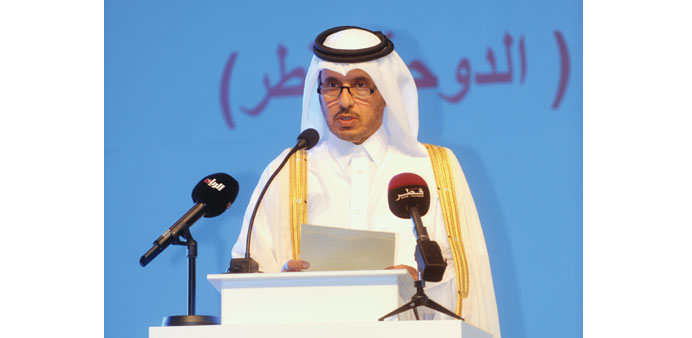
HE Sheikh Abdullah addressing the 15th World Export Development Forum yesterday.
By Peter Alagos
Business Reporter
Qatar’s non-hydrocarbon sector will grow by 10% in 2016, surpassing figures predicted for the country’s oil and gas industry next year, HE the Prime Minister and Interior Minister Sheikh Abdullah bin Nasser bin Khalifa al-Thani said yesterday.
Opening the 15th World Export Development Forum, he stressed that the government had prioritised the development of the country’s small and medium-sized enterprises (SMEs) to boost Qatar’s economy.
Sheikh Abdullah stressed that non-petroleum exports had reached more than QR2bn in 2014, “and doubled five times” through expansion and reaching markets outside GCC countries, including Chile, the US and Australia
“As of July 2015, the volume of non-petroleum exports have reached QR1.5bn. From less than 42%, the non-hydrocarbon sector now accounts for more than 50% of the country’s economy. This industry will grow by 10% in 2016, which is higher than the expected growth of the oil and gas sector,” the Prime Minister said.
This was echoed by HE the Minister of Economy and Commerce Sheikh Ahmed bin Jassim bin Mohamed al-Thani who forecast that the volume of non-oil exports would reach QR3bn in 2016.
“The sustainability of SMEs depends on their ability to find markets to export their goods and the government has exerted efforts to prepare and rear the proper environment for SME growth and development,” he said.
The minister noted that 97% of Qatari businesses belonged to the SME sector, adding that government had implemented comprehensive programmes to support these companies.
“These programmes include the provision of specialised zones and training, logistic, financial and technical support for these companies, in addition to assisting in their growth and introducing them to the local or global market,” he said.
During the forum, the Prime Minister said the government was aware that “the future welfare of our people depends on Qatar’s access to competitive markets, as SMEs represent the vanguard of our exports”.
“It is in this sense that we embrace world markets and welcome discussions on innovation and investment as guiding principles of our public policy that contribute to the development of the private sector, specifically the SME sector,” he said.
Arancha Gonzalez, executive director of the Geneva-headquartered International Trade Centre, said that more open trade and investment, especially more competitive SMEs, could help the world generate “sustainable and inclusive growth” and reach the Global Goals for Sustainable Development, which were agreed by world leaders at the United Nations last month.
“It must be ‘sustainable’ because growth needs to be compatible with our planet and ‘inclusive’ because growth must work for all, including for youth and women. This must be growth anchored in SMEs, which represent 90% of all businesses worldwide and which generate seven of every 10 jobs,” she explained.